Skip to content

I. What is CNC Turn Mill Machine and Its Core Value?
A CNC turning and milling machine is an advanced CNC machining technology. It doesn’t simply combine turning and milling mechanically; instead, it completes multiple machining operations such as turning, milling, and drilling on a single machine tool. Through a CNC system, it coordinates various axial movements to efficiently complete the forming of complex parts.
Compared to traditional machining, mill-turn machining centers have significant advantages such as high process integration, high automation, and high production efficiency. They are essential production equipment in modern manufacturing, especially in industries such as automotive, aerospace, and precision medical devices.

II. Basic Components and Principles of a Milling-Turn Turning Center
A complete milling-turning center mainly consists of the following modules:
• Bed and frame: Provides rigid foundation support
• Spindle system: Used to rotate the workpiece or turning tool
• CNC control system: Executes G-code programs to achieve precise movements
• Feed system and servo drive: Controls the movement of the turning tool and worktable
• Clamping and workpiece clamping system: Ensures reliable workpiece positioning
• Tool magazine and automatic tool changer: Enables automated tool switching
The CNC milling-turning center precisely controls spindle rotation, tool feed, and multi-axis simultaneous through a CNC system (such as FANUC, Siemens, Heidenhain, etc.), enabling the combination and switching of multiple operations such as turning, milling, drilling, and tapping on the same machine tool.
In simple terms, its working principle is to integrate the two motion modes of turning (“workpiece rotating spindle + tool stationary feed”) and milling (“tool rotation + workpiece stationary feed”), and uniformly schedule them within the machine tool controller through CNC system programming, thereby completing multiple machining operations within a single fixture clamping cycle.
III. Complete Workflow of CNC Mill-Turn Machining
A standard mill-turn machining process typically includes the following key steps:
1. Preliminary Preparation – Design and Programming
• CAD Part Modeling: Engineers create a 3D model based on part drawings (e.g., STEP/IGES format).
• CAM Toolpath Planning: Tool strategy design is performed using CAM software that supports mill-turn machining, including turning toolpaths, milling toolpaths, feed rates, and depths of cut.
• CNC Program Generation: The toolpaths output from the CAM are converted to G-code and verified through simulation to eliminate potential interference and collisions.
This stage is crucial for ensuring the overall machining accuracy and efficiency. Proper planning can reduce idle time and optimize tool entry sequence.
2. Workpiece Clamping and Machine Setting
• Clamping: The workpiece is stably fixed using chucks, fixtures, and grippers.
• Machine Zeroing and Tool Setting: The machine tool is zeroed, and the tool length and position are adjusted to ensure accurate reference coordinates for each axis.
• Tool and Material Pre-inspection: Confirm tool wear and set turning parameters.
This step, though seemingly basic, is crucial for precision machining because clamping errors directly affect the accuracy of the finished product.
3. CNC Turning Machining Stage
In turning mode, the workpiece’s main motion is achieved through spindle rotation, while the tool moves along the X, Z, and other axes, completing the following machining operations:
• External turning
• Internal turning
• Tapered and stepped surface machining
• Staged finishing and roughing turning
The core of CNC turning lies in the coordination between high-speed rotation and tool feed to achieve precise dimensions and symmetrical part surfaces.
4. Milling and Composite Machining Stage
After turning, the machine tool automatically switches to milling mode. The turning tool rotates under the drive of the machine tool spindle or power head, while the workpiece remains stationary or continues to rotate:
• Face Milling: Used for processing planes or complex contours
• Side Milling: Machining grooves, bosses, and contour curves
• Drilling and Tapping: Performed axially or radially on the part
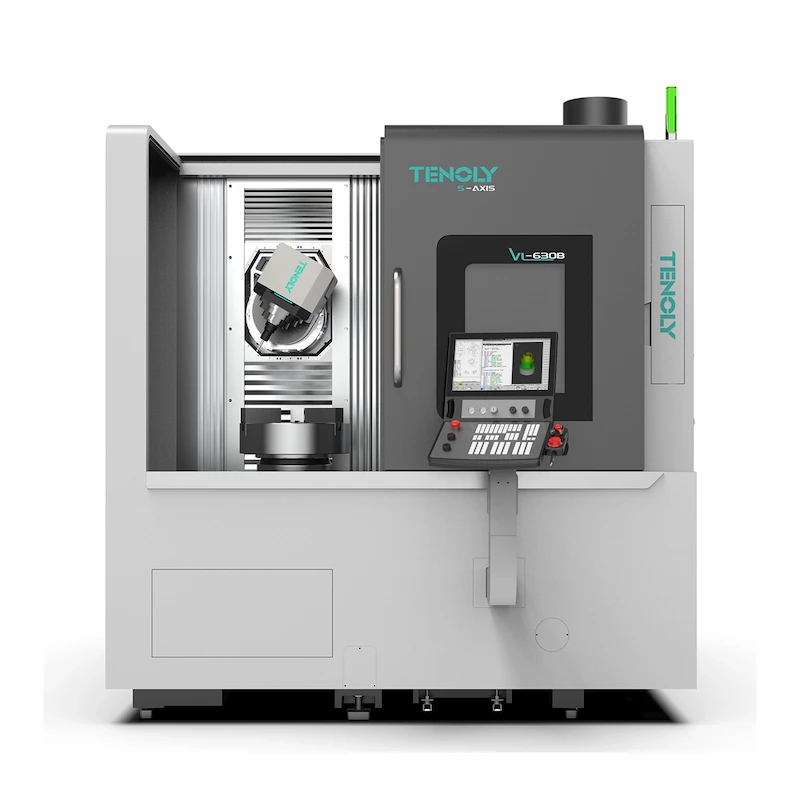
• Complex Multi-Axis simultaneous: 5-axis CNC milling-turning composite machines can perform machining of complex spatial curves.
This step is executed through program scheduling within the control system, achieving automatic tool changes and coordinated movements.
5. Inspection and Post-Processing
CNC milling-turning composite machines are typically equipped with online measurement and compensation functions, enabling real-time dimensional inspection and error correction during machining. After machining, the part is output to an inspection table for final dimensional, surface roughness, and geometric tolerance checks. The advantage of this entire process is that it avoids the repeated clamping and secondary positioning errors between traditional processes.
IV. Efficiency Advantages of Milling-Turn Machining
Compared to traditional single-machine tool + manual handling processes, milling-turn machining centers offer significant efficiency improvements:
• Reduced Workpiece Transfers
No need to move the workpiece from the lathe to the milling machine, greatly reducing the number of workpiece clamping operations.
• Increased Production Cycle Time and Automation
Automatic tool magazines and tool scheduling reduce manual intervention, enabling continuous unattended production.
• Improved Machining Consistency and Precision
Executing all processes within the same coordinate system reduces error accumulation, improving product consistency.
V. Application Scenarios and Procurement Considerations
CNC turn mill machine possess high-precision, medium-to-high batch processing capabilities and are widely used in:
• Key components such as automotive drive shafts and reducer housings
• Aerospace structural components and engine parts
• Precision mechanical bearings and medical implant machining
For procurement decisions, companies should focus on the following when evaluating machine tool performance:
• Spindle speed and power head performance
• Number of axes supported by the control system and AC simultaneous capabilities
• Degree of automation and ease of maintenance
• Supplier service system and spare parts supply