Skip to content

Have you ever faced this dilemma: a lathe has just finished turning the outer diameter and face of a part, but because there is an off-center hole on the side—or a flat hexagonal profile needs to be machined—you are forced to unload the part and send it to a CNC machining center for further processing?
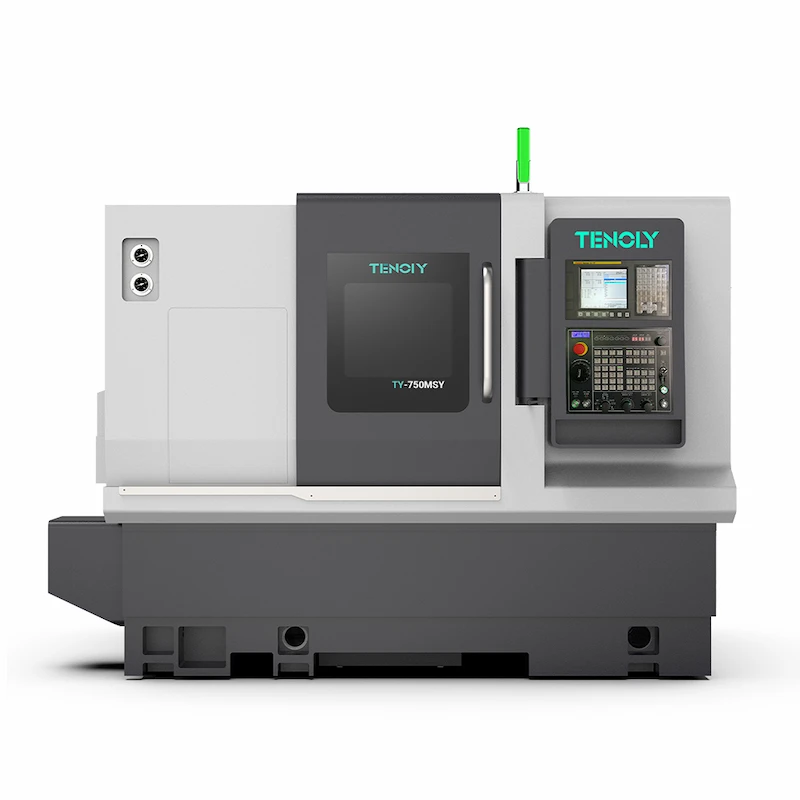
This not only extends production cycles and increases labor costs but also significantly compromises the part’s coaxiality and positional accuracy.
If you are evaluating whether to purchase a CNC turning center with a Y-axis, or considering recommending a Y-axis machine to a client, there is only one core criterion: the Y-axis is essential when your part requires milling, drilling, or tapping off the turning centerline (at an eccentric position), or when you aim to complete all operations in a single setup.
The Fundamental Difference Between C-Axis and Y-Axis
Many people confuse the C-axis (spindle indexing and interpolation) with the Y-axis.
C-axis + Driven Tool Turret: The tool can only move radially (X-axis) or axially (Z-axis) relative to the lathe’s centerline. You can use the C-axis to drill holes in a circular pattern around the face center or cut a slot along the exact centerline of the side. However, if the machining location deviates from the spindle centerline, the C-axis alone cannot handle the task.
Y-axis: In addition to the X and Z axes, the Y-axis adds a linear motion dimension perpendicular to the spindle centerline. It enables the tool to move up and down, breaking free from the physical limitation of cutting only along the centerline.
4 Typical Machining Scenarios Requiring a Y-Axis
1. Machining Eccentric Holes and Slots
Whenever a hole or slot on the blueprint is not located on the part’s central axis (such as an eccentric oil hole or sensor mounting hole on the side of a shaft-type part), the tool center cannot align with the machining point without a Y-axis. Attempting to approximate the position using only the C-axis results in extremely poor accuracy and a high risk of tool breakage.
2. Side Milling of Flats and Polyhedral Cutting
While it is possible to mill flat surfaces using the C-axis and driven tool turret, the tool follows an arc-like enveloping path, often resulting in slight curvature errors at the edges of the machined surface. With the Y-axis, standard linear interpolation allows for the milling of perfectly flat surfaces and regular polyhedral shapes.
3. Milling Wide Keyways and Complex Surfaces
Machining keyways wider than the tool diameter requires lateral movement and tool offset compensation along the Y-axis. Without a Y-axis, you would be forced to use a tool exactly the width of the keyway and “force” the cut; this makes tolerance control extremely difficult and significantly shortens tool life.
4. Achieving “One-Stop” Machining
If your workshop is facing production bottlenecks—such as turners waiting for millers, or millers waiting for bench workers—CNC turning center equipped with a Y-axis and sub-spindle offers the solution. It highly integrates the functions of a traditional lathe and a 3-axis machining center, enabling a process where raw stock goes in and a finished part comes out.
Comparison of CNC Lathe Configuration Options
| Machine Configuration | Primary Machining Capabilities | Off-Center / Off-Axis Capability | Secondary Setup Risk | Suitable Workpiece Types |
| Standard 2-Axis Lathe (X/Z) | Basic turning (OD, ID, facing, threading) | None | High (Requires secondary machines) | Simple rotational parts |
| 3-Axis Lathe (X/Z/C + driven tool turret) | On-center drilling, tapping, and centerline keyways | Centerline only | Medium (Off-center features require secondary ops) | Standard rotational parts with centerline holes/slots |
| 4/5-Axis Turning Center (+ Y-Axis / Sub-Spindle) | Turning + off-center drilling, flat milling, wide keyways, polyhedra | Fully capable | Extremely low (Completed in one setup) | High-precision, complex multi-feature components |
Practical Recommendations
When evaluating or recommending Y-axis equipment, do not limit your focus solely to the initial purchase price. While Y-axis turning centers typically cost 30% to 50% more than standard lathes, determining the investment’s value requires calculating the comprehensive ROI:
- Consider processes and cycle times: Eliminating a secondary setup not only saves on the design and manufacturing costs of specialized fixtures but also eliminates the non-productive time spent waiting for and transporting parts between different machines.
- Consider precision and scrap rates: Multiple setups are the primary cause of deviations in coaxiality and positional accuracy. Calculating the cost of scrap resulting from secondary setups often reveals a significant financial loss.
- Consider delivery times and responsiveness: Achieving “Done in One” processing (completing all machining in a single setup) drastically shortens delivery cycles, creating a strong competitive advantage when handling urgent or complex orders.
Three Diagnostic Questions for Selection and Evaluation
Whether selecting equipment for internal use or recommending a purchase to a partner, you can make a quick decision by asking these three core questions:
- Process flow: After the initial turning operation, does the workpiece require transfer to a machining center or milling machine for secondary processing?
- Quality bottlenecks: Is the control of coaxiality and tolerances stable when machining off-center holes, slots, or prismatic features on the side? What is the current scrap rate?
- Comprehensive cost-benefit analysis: If you convert the savings—reduced labor costs, lower scrap rates, and shorter delivery times—into monetary value, can the additional purchase cost of the Y-axis machine be recouped within 6 to 12 months?
Whenever a product features off-center structures, or a production line faces bottlenecks in capacity or precision, a Y-axis machine ceases to be an “expensive option” and instead becomes an essential productivity tool that significantly boosts workshop profitability.