Skip to content

Many small and medium-sized machine shops are often confused about the boundaries between CNC turning center, CNC milling machine, and CNC mill-turn center. As a result, production capacity falls short of standards, accuracy is substandard, delivery times are frequently delayed, and investments are easily wasted. This article systematically compares the differences between turning centers and milling centers, helping owners, engineers, and purchasing personnel quickly choose the right machine tools to improve production line efficiency and competitiveness.

Contents:
Basic Concepts
Comparison of Machining Capabilities
Key Difference Dimensions Table
How to Choose Between a Turning Center and a Milling Center Based on Parts and Orders?
Mill-Turn Machining Center
Summary
I. CNC Turning Center vs. CNC Milling Center
1. Basic Concepts
A CNC turning center is essentially an upgraded version of a CNC lathe. The workpiece rotates at high speed, and the turning tool feeds along a straight line or curve. It mainly processes rotating parts such as shafts, discs, sleeves, and flanges, such as automotive drive shafts and valve fittings.
CNC milling centers, on the other hand, rotate the turning tool at high speed while the workpiece remains relatively stationary. They feed in multiple directions along the X, Y, and Z axes, making them adept at machining complex non-rotational parts such as housings, mold cavities, and shells, including aerospace structural components and precision molds.
The fundamental difference between turning centers and milling centers lies in their mode of motion, which directly determines their machining capabilities.
| CNC Turning Center | CNC Milling Center | |
| Movement Type | Workpiece moves, tool is stationary | Tool moves, workpiece is stationary |
| Main Motion | Workpiece rotation | Tool rotation |
| Feed Motion | Tool moves axially or radially | Workpiece performs linear or curved motion |
| Movement Path | Circular Motion | Linear or Complex Curved Motion |
2. Machining Capability Comparison
CNC turning centers excel at high-volume production of rotating parts: external turning, internal boring, threading, and grooving, achieving high surface finish and good coaxiality. With automatic bar stock feeding, they can operate unattended for several days
CNC milling centers, on the other hand, focus on multi-faceted, multi-hole, and multi-process machining: face milling, side milling, drilling, tapping, and roughing and finishing of cavities. They can handle complex contours of box-shaped structures or molds in a single setup, offering high flexibility suitable for small batches.
Turning prioritizes “fast and accurate circles,” while milling emphasizes “comprehensive and stable shapes.”
3. Key Difference Dimensions Table
| Dimension | CNC Turning Center | CNC Milling Center |
| Motion Mode | Workpiece rotation + Tool linear feed | Tool rotation + Multi-axis synchronous feed |
| Typical Workpieces | Shafts/Discs/Sleeves/Flanges (Rotational Parts) | Boxes/Housings/Molds (Complex-shaped Parts) |
| Axis Configuration | X/Z axes as standard + Optional C/Y axes | X/Y/Z axes standard + Optional 4/5 axes |
| Machining Efficiency | High efficiency for mass-produced shafts | Comprehensive efficiency for multi-sided parts |
| Machine Cost | Relatively affordable | More costly for multi-axis models |
| Operational Difficulty | Simple with fewer processes | Complex with more tool paths |
II. How to Choose Between a Turning Center and a Milling Center Based on Parts and Orders?
Step 1: Determine Based on Part Shape (Most Critical Factor)
· Choose a Turning Center: For parts that are rotating (symmetrical about a central axis), such as shafts, discs, and sleeves. Even if the part has simple non-rotating features (such as small facets on a shaft), a turning center equipped with a power tool holder (optional) can complete the machining at a lower cost.
· Choose a Milling Center: For parts that are non-rotating with complex features (such as planes, grooves, curved surfaces), such as engine blocks or mold cores. For parts with both rotating and non-rotating features (such as shafts with square ends), a milling center can be used, but the efficiency may be lower than a CNC mill-turn composite machine.
Step 2: Consider Order Batch and Production Efficiency
· High-volume production (over 1000 pieces per batch) of rotating parts: A turning center equipped with a bar feeder and automatic tool changer is the best choice (high efficiency, low labor costs).
• Small-batch, multi-variety production of complex parts (10-100 pieces per batch): Milling centers (especially 3-axis or 5-axis) are more flexible (fast programming switchover, no need for multiple clamping).
Step 3: Assess Accuracy Requirements
• High precision requirements for rotating surfaces (e.g., coaxiality ±0.002mm): High-end turning centers are more reliable (designed specifically for rotary machining, less vibration).
• High precision requirements for complex curved surfaces (e.g., 3D mold core tolerance ±0.005mm): Requires a 5-axis milling center equipped with a high-speed spindle.
Step 4: Balance Investment and Return
• Main products are rotating parts: Prioritize investment in turning centers (lower cost, faster return on investment).
• Need to process diverse and complex parts to expand the market: Milling centers are a long-term investment (increases capacity and competitiveness).
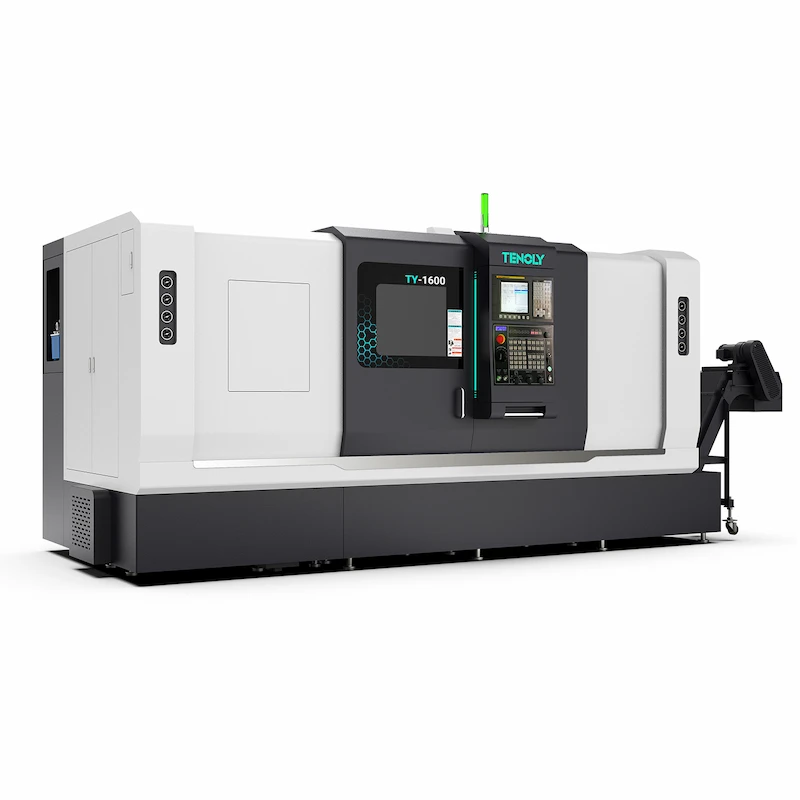
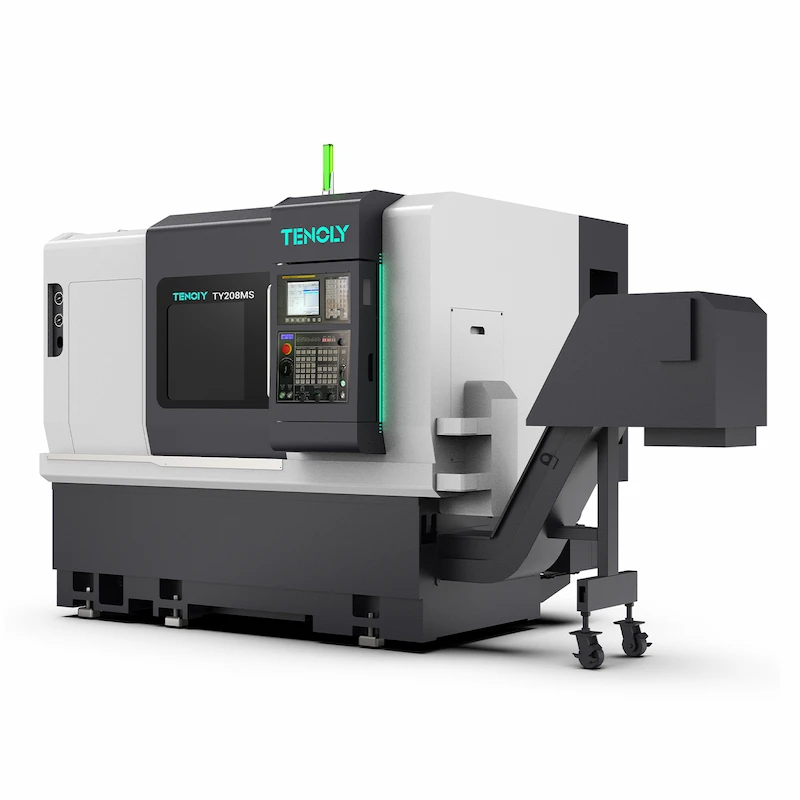
III. Tenoly Focuses on Mill-Turn Machining Centers
When your parts have both cylindrical rotating surfaces and complex side milling requirements, a mill-turn machining center is the best choice. It integrates the turning spindle rotation and high-speed turning capabilities of a milling power head on a single machine tool, supporting multiple processes such as drilling and tapping. All machining can be completed in a single setup, making it suitable for complex rotating parts.
Tenoly focuses on developing high-precision CNC mill-turn machining centers, particularly suitable for complex rotating parts such as aerospace turbine disks, automotive turbine housings, and medical devices. It can reduce the number of setups by 80%, shorten the machining cycle time by 30%, significantly reduce positioning errors and labor costs, allowing small and medium-sized factories to easily secure high-value-added orders.
Summary
Choosing between a turning center and a milling center is not difficult. Remember: turning centers are used for efficient machining of rotating parts, while milling centers are used for general machining of complex non-rotating parts. If your machining needs involve complex parts requiring both types of machining, the Tenoly mill-turn machining center is the most cost-effective solution—it solves both accuracy and efficiency issues while reducing investment risk.
Still unsure which machine tool is right for your workshop? Contact Tenoly’s professional technical team now—we’ll provide customized equipment selection solutions based on your part drawings, order requirements, and budget.
Let Tenoly help you optimize your production lines, enhance competitiveness, and achieve profit growth.