Skip to content

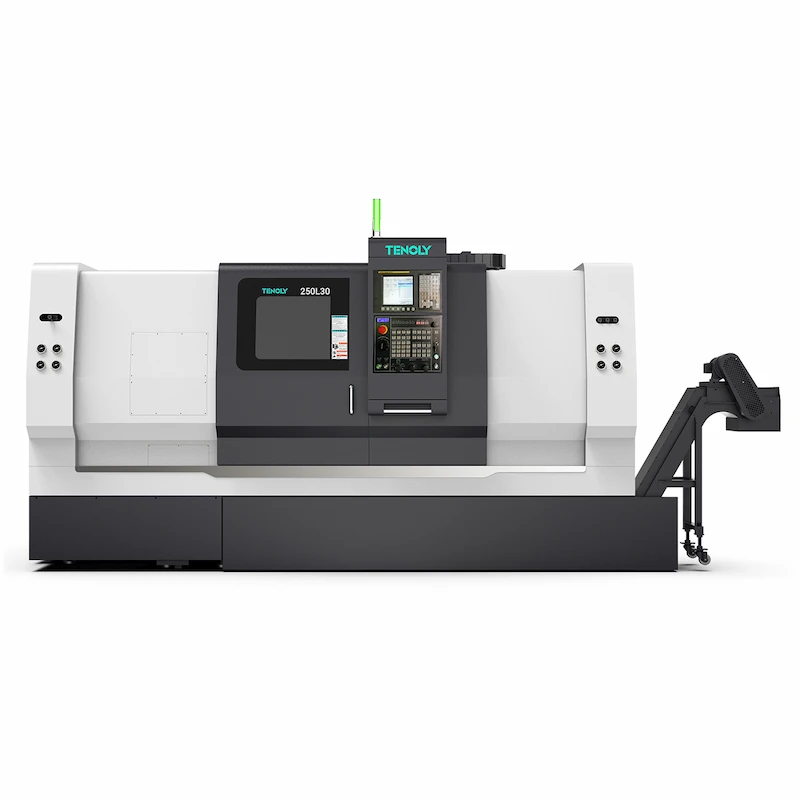
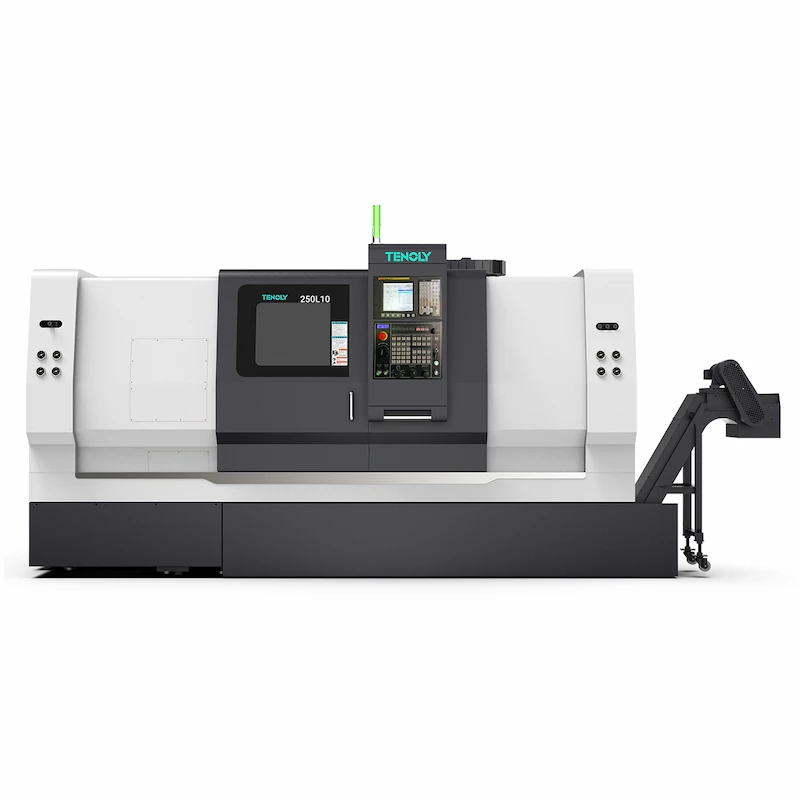
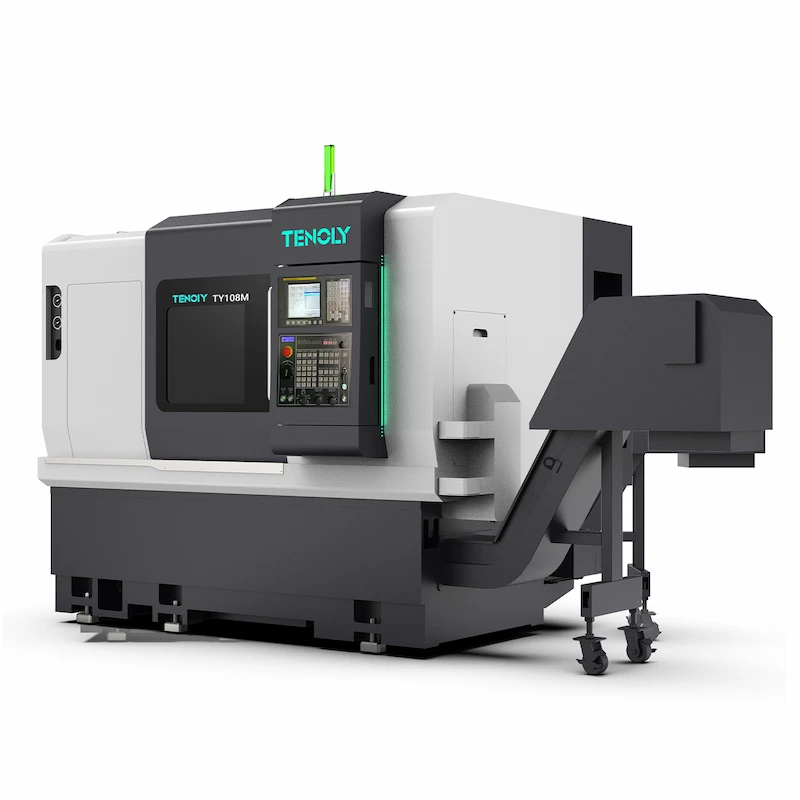
A CNC turning center integrates milling, drilling, boring, and sub-spindle functions on a lathe platform, enabling multi-process machining of complex parts in a single setup. It is widely used in the production of high-precision parts in aerospace, automotive manufacturing, electronics and communications, and medical devices.
Its core lies in the Computer Numerical Control (CNC) system, which precisely controls multi-axis linkage through G-code programming, improving machining efficiency by over 30% and ensuring micron-level accuracy. This article details the core components, working principle, and application advantages of CNC turning centers.

Working Principle of a CNC Turning Center
CNC turning center uses a CNC system as its “brain,” consisting of a central processing unit, memory, servo drives, and a PLC. After receiving the machining program, it calculates the tool path, achieving synchronous linear motion on the X/Y/Z axes and rotation on the C-axis. The operator inputs the NC program generated by CAM, and the system automatically controls the spindle speed (up to 6000 r/min), feed rate, and tool change, completing external turning, end face drilling, and radial milling in one operation, avoiding multiple setup errors.
Compared to traditional lathes, it supports Y-axis transverse feed and a power turret, enabling milling and turning operations, reducing machining cycles by 50%, and achieving a surface roughness of Ra0.8μm. It is suitable for difficult-to-machine materials such as titanium alloys and stainless steel. Real-time feedback monitoring ensures dynamic accuracy, and self-diagnosis functions reduce downtime.
Structure
Bed: The rigid foundation of the machine tool
The bed is the load-bearing structure of the CNC turning center, typically made of high-strength cast iron or mineral casting materials. The 30° slant bed design optimizes chip removal and improves stability, withstanding turning forces exceeding 10kN. Precision linear roller guides (load > 50kN/m) ensure X/Z axis movement accuracy < 0.005mm/300mm, with thermal deformation controlled within 3μm, supporting long-term heavy-duty machining. The slant bed layout lowers the center of gravity and improves vibration resistance, making it suitable for machining aerospace blade shafts and automotive gears.
Spindle Box: Core of Power Output
The spindle box integrates a high-precision servo motor, built-in spindle, and ceramic bearings, supporting dual-spindle configurations for synchronous front and rear machining.
Spindle speed ranges from 50-5000 r/min, with power from 15-30 kW. A hydraulic chuck provides rapid clamping (<2s), and C-axis positioning supports milling indexing, ensuring cylindricity <0.003mm. The sub-spindle design allows for workpiece transfer, enabling front and rear drilling or turning, improving efficiency by 40%, commonly found in mass production of electronic connectors.
Tool Holder and Tool Changer System: Key to Machining Flexibility
The tool post uses a servo-driven electric or hydraulic turret, with 12-24 position configurations, supporting rapid switching between turning tools, milling turners, and drills (<0.5s). Y-axis travel of ±50mm enables eccentric machining. A self-driven power head provides independent spindle power (5kW), completing inclined hole milling and thread machining without secondary transfer.
The ATC automatic tool changer integrates tool life management, reducing manual intervention and supporting complex contours such as multi-faceted clamping of aerospace rotors.
Feed and Drive System: Precision Control Guarantee
The feed system consists of an AC servo motor, ball screw, and linear encoder, achieving a resolution of 0.001mm, enabling nanometer-level interpolation motion, and a dynamic response of <1ms. Closed-loop feedback control eliminates backlash, ensuring a positioning accuracy of <0.004mm and supporting high-speed feed of 36m/min.
Dual-drive configuration enhances the stability of large workpieces, suitable for long-axis parts such as medical implants.
Cooling, Lubrication, and CNC System: Auxiliary and Intelligent Core
The cooling system uses high-pressure jet (70bar) to flush away chips and prevent thermal deformation; lubrication employs a centralized timed and metered grease pump, reducing friction by 30%. CNC systems such as the Fanuc 31i support IoT networking, real-time monitoring of vibration/temperature, predictive maintenance intervals, and compatibility with UG/POWERMILL software.
Safety door interlocks and laser tool setters enhance operational convenience.
Advantages and Selection Recommendations for CNC Turning Centers
CNC turning centers complete 95% of machining operations in a single setup, reducing costs by 20%, and achieving IT6 precision. They are suitable for automotive gearbox shafts, aerospace fasteners, and precision instrument parts.
When selecting a CNC turning machine, prioritize a high-rigidity bed, dual-channel control, and a high-power spindle, and assess ROI based on your company’s batch production needs.
Summary
CNC turning centers achieve high-efficiency precision machining through multi-axis integration and intelligent control, driving the transformation to intelligent manufacturing. Tenoly provides advanced CNC turning centers equipped with high-rigidity slant beds, dual spindles, and powered turrets, supporting one-time forming of complex aerospace and automotive parts, helping companies improve productivity and quality.