Skip to content

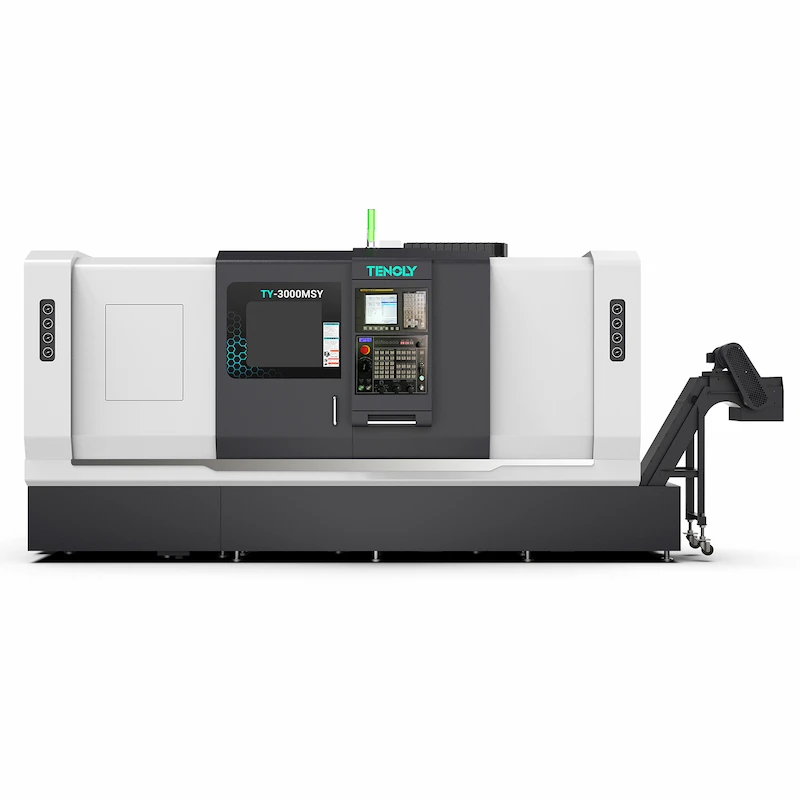
As automotive manufacturing demands increasingly stringent requirements for the efficiency, precision, and consistency of parts processing, slant CNC lathes, with their unique structural design and superior performance, have become crucial equipment for the production of key automotive components. Whether manufacturing crankshafts, half-shafts, or steering knuckles, slant-guide CNC lathes demonstrate highly efficient and precise machining capabilities, precisely because their design closely aligns with production needs.

The slant-guide structure is fundamental to achieving high-efficiency machining. Compared to traditional flat-bed structures, the guideways are arranged at an angle of 30° to 60°, allowing chips to be naturally discharged from the turning zone. This avoids interference and downtime caused by chip accumulation, significantly improving machine tool stability and machining continuity. Simultaneously, the slant-guide bed and guideways utilize an integrated casting design, and after aging treatment, the overall rigidity is enhanced, allowing it to withstand greater turning forces. This high-rigidity structure maintains turning stability when machining high-strength automotive bolts and other workpieces, ensuring dimensional accuracy and avoiding errors caused by vibration.
In terms of process optimization, slant-guide CNC lathes possess excellent integrated machining capabilities. The CNC equipped with a turret and sub-spindle, they can achieve a “one-time setup for all processes” machining mode. For example, when machining automotive drive shafts, after the main spindle completes the outer diameter turning, the sub-spindle immediately picks up the material to machine the thread on the other end, effectively reducing the number of setups and auxiliary time, shortening the single-piece production cycle by more than 25%. The turret’s rapid tool change (typically less than 0.5 seconds) supports the continuous completion of multiple processes. For example, for flanged half-shafts, turning, drilling, and tapping can be completed on a single machine tool, significantly reducing accuracy loss between processes.
The slant-guide CNC lathes also exhibit excellent precision performance. High-rigidity guideways combined with precision ball screws enable tool holder movement resolution of 0.001 mm. When machining the inner ring of automotive wheel hub bearings, the roundness error can be controlled within 0.003 mm, fully meeting the stringent clearance requirements of bearing assembly. The slant bed structure allows the workpiece’s weight and turning force to form a reasonable angle, effectively reducing workpiece deformation. Especially for thin-walled parts, such as automotive clutch housings, this design minimizes radial runout, ensuring effective sealing during subsequent assembly.
For the mass production needs of the automotive industry, slant-bed CNC lathes also possess strong automation compatibility. By incorporating robotic automatic loading and unloading systems and online inspection equipment, the machining process can be automated. Taking an automotive gearbox gear shaft as an example, the robot feeds the blank into the spindle, and after machining, the inspection device automatically completes key dimension measurements. Qualified products proceed directly to subsequent processes, requiring no manual intervention. The CNC system supports the storage and rapid switching of multiple machining programs. When switching vehicle models, program recall and equipment adjustment can be completed within 10 minutes, ensuring flexible and efficient production.
The successful application of the slant bed CNC lathe in automotive manufacturing is the result of a deep integration of structural innovation, intelligent integration, and manufacturing requirements. Facing the trend of lightweight and high-precision automotive parts, this equipment plays an irreplaceable role in improving production efficiency and ensuring machining quality, gradually becoming an important technological support for automotive manufacturers to achieve quality and efficiency improvements.