Skip to content

As a manufacturer dedicated to the R&D and automation of mid-to-high-end CNC machine tools, we offer not only CNC equipment but also specialize in providing comprehensive turnkey services, ranging from process planning to full automation integration. Faced with the challenges of labor shortages and mounting pressure to expand production, selecting the right machine tool is the key to avoiding “redundant investment.” This article will break down exactly why the *slant-bed* design represents the most value-retaining choice in the era of automation, helping you secure a competitive edge for the next three years.

I. Physical Chip Evacuation:
The Pain Points of Flat-Bed Designs: In traditional flat-bed machine tools, the machining area is horizontally oriented. During the turning process, metal chips tend to accumulate easily on the guide rails, lead screws, and the surface of the workpiece. This necessitates regular manual cleaning; while an operator might casually clear chips with an air gun, within an automated workflow, accumulated chips can entangle turning tools, scratch machined surfaces, or even trigger sensor malfunctions that lead to unplanned downtime.
The Advantages of Slant-Bed Designs:
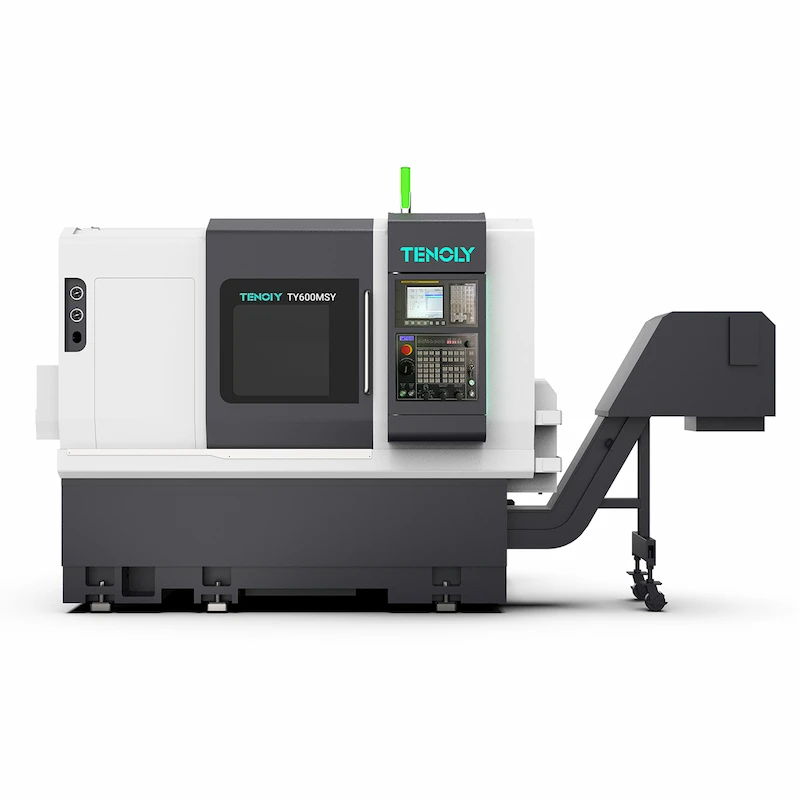
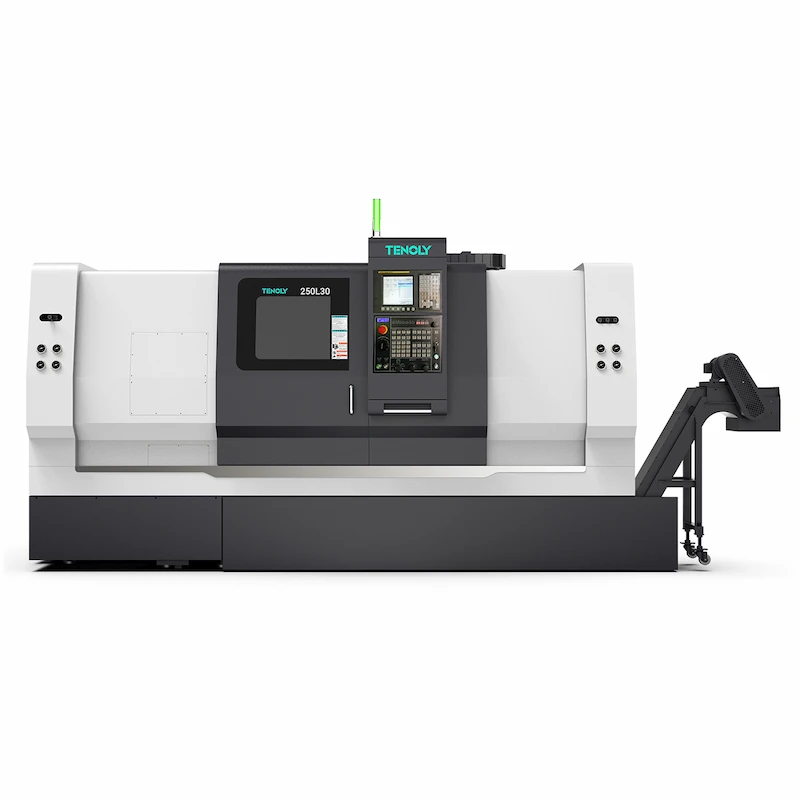
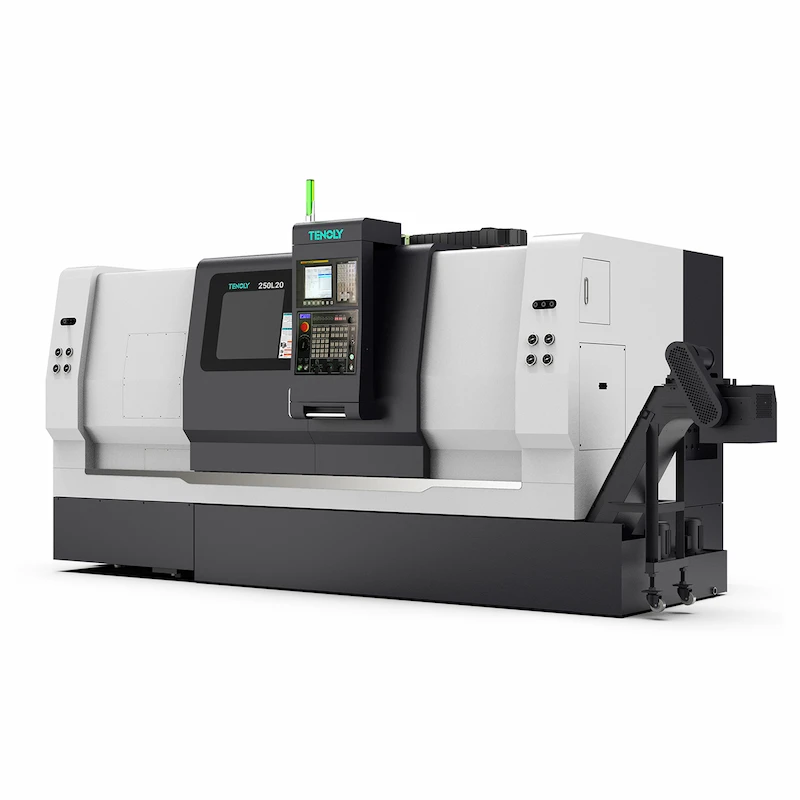
- Gravity-Assisted Evacuation: Tenoly’s CNC turning centers typically feature a 30° or 45° slant-bed design. The core principle lies in harnessing physical gravity: the moment chips are generated, they slide directly down the inclined surface into the chip conveyor located at the base of the machine.
- High-Flow Flushing: When paired with a high-pressure, high-flow coolant system, the fluid flows naturally downward, eliminating the need for manual intervention to clear chips and ensuring the machining area remains consistently clean.
Tenoly’s Recommendation: Without a solution for chip evacuation, true 24-hour unattended operation remains an impossibility. If your parts involve heavy material removal or are made from high-toughness materials, we strongly recommend choosing a slant-bed CNC lathe; it is the most effective way to ensure the continuous operation of your production line.
II. Spatial Layout:
Automation is not merely a simple combination of “machine tool + robotic arm,” but rather involves deep integration within the physical workspace.
Center of Gravity Comparison: Thanks to its inherently stable triangular structure, the slant-bed machine tool possesses a lower center of gravity, resulting in superior dynamic stability during operation. This means the machine is better equipped to absorb vibrations and maintain precise positioning—even during the high-speed, frequent loading and unloading cycles performed by robotic manipulators.
Eliminating Interference Issues:
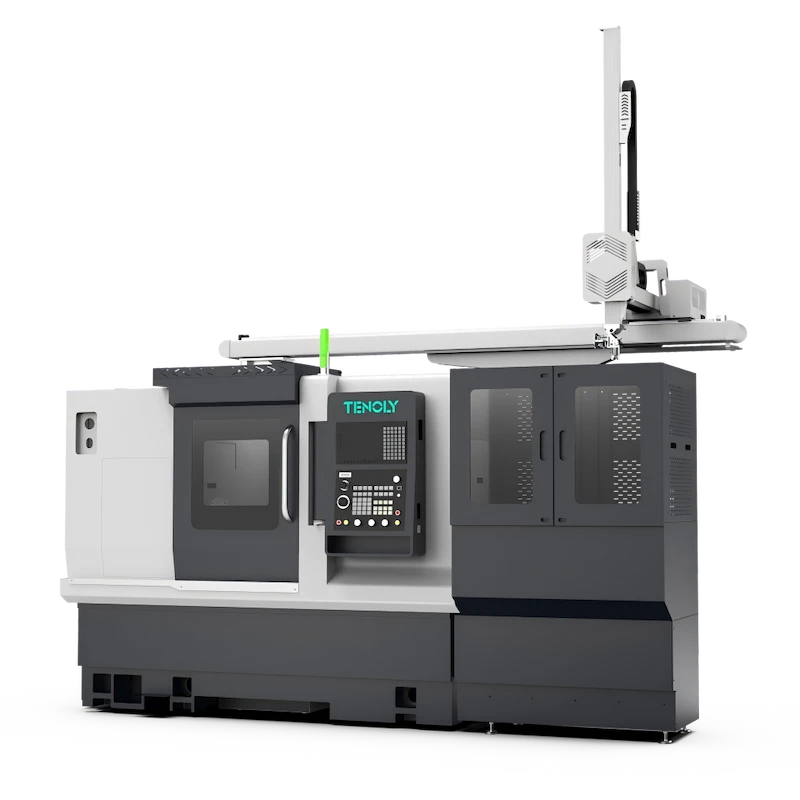
When retrofitting a robotic arm onto a standard flat-bed machine, one frequently encounters spatial interference issues involving the opening/closing travel paths of the safety doors, the tool-changing trajectory of the turret, and the movement envelope of the robotic arm. In contrast, Tenoly’s slant-bed machine tools feature a rear-mounted guide rail design; by shifting the transmission structure toward the back, they create an exceptionally spacious clamping area at the front. Whether a gantry robot is performing a precise pick-and-place operation from above, or a collaborative robot is feeding parts from the side, the layout provides natural clearance paths. This significantly reduces the complexity of debugging and the costs associated with secondary modifications during automation integration.
III. Rigidity and Precision
The primary advantages of automated production lie in its high frequency and high efficiency; however, this places rigorous demands on the machine tool itself.
Structural Load-Bearing: On a slant-bed machine, the turning forces generated by the spindle tend to align with the direction of the machine tool’s own gravitational force. This specific load-bearing characteristic endows the machine with exceptional vibration resistance during high-speed, heavy-duty turning operations. It effectively suppresses tool chatter marks, thereby directly enhancing the surface finish of the machined parts.
Thermal Deformation Control: Automated production typically entails machine tools operating at high frequencies and for extended durations. Flat-bed machines, due to their relatively poor structural symmetry, are prone to spindle center displacement caused by thermal expansion. In contrast, the casting structure and heat dissipation pathways of a slant-bed CNC lathe are far more conducive to effective thermal compensation control. This ensures that the ten-thousandth product produced during a continuous automated run maintains the exact same geometric and positional tolerances as the very first product.
IV. Return on Investment
Having worked in the CNC machine tool industry for many years and collaborated with numerous clients, I have observed that their focus extends beyond just the initial purchase price; they are equally concerned with the long-term return on investment. Allow me to help you clearly calculate the financial implications—both for the present and the future.
Avoiding Sunk Costs: While the initial cost of purchasing a flat-bed CNC lathe may be low, if you have plans to implement automation within the next three years, I strongly advise against choosing a flat-bed model. Its compatibility with automation systems is inherently low; attempting to retrofit a robotic arm later will incur exorbitant costs for custom modifications. Furthermore, you may face a scenario where—due to incompatibility—you are forced to sell off your old machine at a significant loss. Such “redundant investment” constitutes a major managerial blunder in factory operations.
Upgrade Potential:
- Reserved Interfaces: Tenoly’s machine models are designed with foresight, featuring pre-reserved standard communication protocols and physical interfaces specifically for automation integration.
- Comprehensive Process Integration: Slant-bed machine models are easily integrated with a sub-spindle, enabling automated, seamless machining of both the front and back sides of a workpiece. This means your workflow can evolve from simple “material handling” into a “raw material in, finished product out” closed-loop production system—truly doubling your operational efficiency.
FAQ
If my parts require only simple machining processes, do I still need to purchase a slant-bed lathe?
If your parts require only simple turning operations and you are not under significant pressure regarding production volume, a basic flat-bed lathe may indeed offer a quicker return on investment. However, if your goals include achieving a zero-defect rate, extending tool life, and ensuring the ability to seamlessly integrate robotic arms in the future, a slant-bed lathe represents a more robust and secure long-term asset.
How does Tenoly support our transition to automation?
We provide more than just hardware. Based on your part drawings, Tenoly’s technical team offers comprehensive technical support—ranging from optimizing machining processes and designing custom fixtures to integrating automation communication protocols.
If we need to machine parts of varying specifications, how quickly can a slant-bed automated system switch between production runs?
Very quickly. The spacious interior of a slant-bed lathe is naturally well-suited for quick-change fixtures and tool holders. Combined with Tenoly’s parametric programming recommendations, you can achieve product changeovers in a matter of minutes. For “low-volume, high-mix” production models, the agility of a slant-bed lathe far surpasses that of traditional machine tools, significantly alleviating pressure on your delivery schedules.
Our current budget is limited; can we purchase the standalone machine now and have a third party install a robotic arm later?
Once a robotic arm is installed, is the machine’s protective enclosure sufficient? Won’t the coolant spray everywhere?
Final Thought
Selecting a machine tool is not merely about purchasing a piece of equipment; it is about securing the future productivity of your operations. The slant-bed lathe stands as a cornerstone of modern manufacturing—engineered specifically for high-precision machining and automation. At Tenoly, we deliver not only high-performance equipment but are also dedicated to helping you build a high-return, sustainable future powered by automation. If you have any questions regarding CNC machine tools or automation, we invite you to contact our team of experts and let us work together to define the most efficient machining solution.