Skip to content

In the field of wind turbine main shaft processing, what truly determines whether a company can make a profit is never “whether the equipment can process the part,” but rather whether it can consistently and efficiently produce the same part repeatedly.

Many companies, when order volumes are small, can still manage with multiple ordinary lathes and boring machines working on different processes; however, once they enter the mass production stage, the problems become very real, such as frequent clamping, longer cycle times, fluctuating accuracy, and increased rework rates, ultimately directly impacting costs and delivery times.
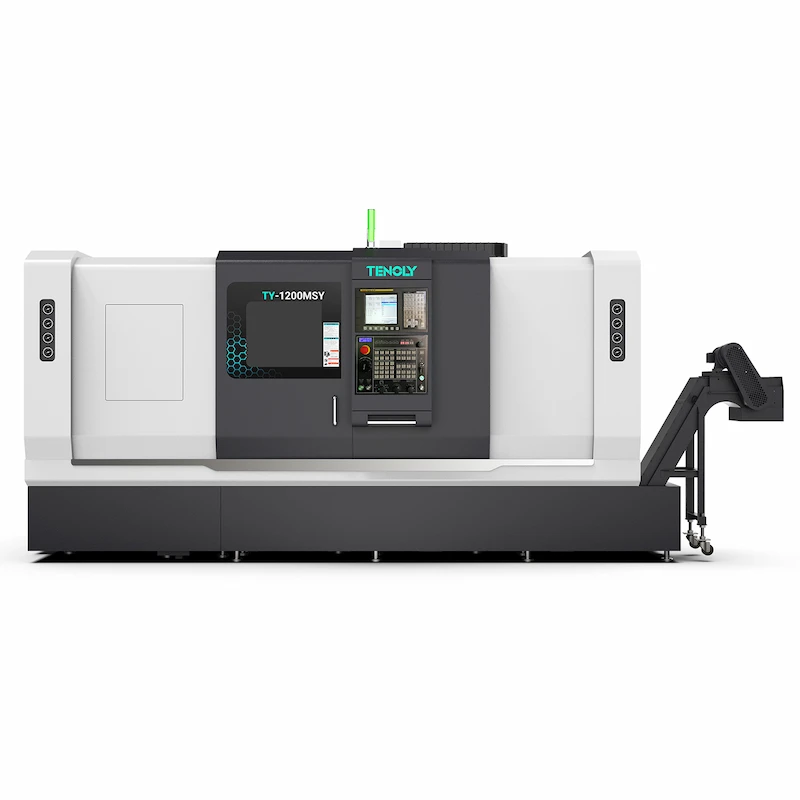
It is against this production backdrop that CNC turning and milling center have begun to be widely introduced into wind turbine main shaft processing. It’s not “high-end for the sake of being high-end,” but rather a practical solution increasingly adopted by production managers, process engineers, and purchasing decision-makers to address mass production consistency and efficiency bottlenecks.
I. Industry Background and Challenges of Wind Turbine Main Shaft Processing
Wind turbine main shafts are typically made of high-strength alloy steel and have complex structures, including journals, keyways, flanges, and other geometric features. The actual processing requires multiple processes such as turning, milling, and drilling. This structure and material properties demand higher requirements for accuracy, surface quality, and production efficiency.
Traditional processing methods often use multiple independent machine tools to complete different processes, requiring re-clamping after each process. Although seemingly simple, this method leads to several core problems:
• Cumulative positioning errors due to multiple clamping operations
• Increased production cycle time due to workpiece handling between different equipment
• Difficulty in achieving stable mass production consistency and product quality, leading to high rework rates
These problems directly affect production efficiency and cost control, and also constrain the large-scale development of wind turbine main shaft processing.
II. Advantages of Turn-Mill Machining Center
1. Multi-process machining completed in a single clamping operation
The biggest advantage of CNC turn-mill center is the integration of traditional turning and milling processes into a single piece of equipment. This means:
• Complete processing of turning, milling, drilling, etc., in a single clamping operation
• Avoidance of handling errors between traditional multiple machine tools
• Continuous execution of turning paths, improving processing efficiency
For complex parts like wind turbine main shafts, reducing the number of clamping operations is crucial for the dimensional accuracy and repeatability of the product.
2. High rigidity and High-precision output
As a large-scale structural component processing equipment, CNC turning and milling composite machines typically feature:
• Reinforced bed structure and high-power spindle
• High-precision transmission components and thermal deformation compensation technology
• Advanced real-time error detection and correction control system
These technologies effectively help address challenges such as large material removal, dynamic turning vibrations, and thermal deformation, thus ensuring consistency and stability in mass production.
3. Intelligent and flexible manufacturing capabilities
Modern CNC turning and milling composite machines have integrated intelligent control systems and simulation software, allowing for simulation and verification of complex paths before processing. This not only:
• Allows for faster adjustment of process parameters
• Reduces trial turning costs
• Enables efficient conversion between multiple varieties and small batches
At the same time, through modular tool magazine design and variable spindle configurations, it can adapt to different megawatt-level spindle sizes, meeting the needs of multi-variety mass production.
III. Why is Turning and Milling Composite Machining a Trend for Large-Scale Production?
1. Process integration
The essence of large-scale production lies in reducing unit costs, improving production efficiency, and ensuring consistent quality output. CNC turning and milling composite machines fundamentally solve the efficiency and precision bottlenecks of traditional processing modes by integrating multiple processes into one. This is a key path to achieving mass production for the rapidly growing wind power industry.
At the same time, modern wind turbine spindle parts require extremely high precision, not only meeting geometric dimension tolerances but also ensuring surface quality and dynamic balance performance. In this environment, the high integration and precision control advantages of composite machining machines are further highlighted.
2. Accelerating the trend of domestic substitution of imported equipment
Currently, domestic machine tool manufacturers have made significant progress in CNC turning and milling composite machine technology, effectively addressing the pain points of imported equipment in terms of cost and service cycle, making domestic equipment more readily accepted by wind turbine spindle manufacturers. This not only shortens delivery and maintenance response times but also promotes the market penetration of domestic equipment in medium and large-scale equipment manufacturing.
3. Alignment with the overall trend of intelligent manufacturing in the industry
Chinese manufacturing is transforming towards intelligent manufacturing and equipment digitalization. The digital control and intelligent process integration capabilities of composite machining machines naturally align with this trend. Foreseeable future developments include:
• Integration with production systems such as MES/ERP
• Real-time monitoring of the machining process
• Overall equipment simultaneous and optimized scheduling
These capabilities are indispensable components of future large-scale manufacturing.
IV. Practical Application Value and Industry Impact
1. Significant cost reduction and efficiency improvement
Turning-milling composite machining significantly improves processing cycle times while reducing equipment investment and factory space requirements. Compared with traditional multi-machine tool processing:
• Reduced movement and clamping time
• Increased equipment utilization
• Reduced labor costs and material handling losses
This efficiency improvement is particularly crucial. In the context of increasing competition in the wind power equipment market, reducing production costs directly enhances corporate competitiveness.
2. More stable product quality
Integrated processing ensures the relational accuracy of parts and reduces human intervention. This not only improves the quality consistency of each product but also effectively increases the pass rate of subsequent quality inspections.
3. Supporting large-scale, high-volume manufacturing needs
As the size of main shafts for large wind turbine units gradually increases, the complexity and difficulty of single-piece processing also increase. The rigidity, precision, and automation level of turning-milling composite machining make this type of large-part processing possible and economically viable, which has long-term significance for the overall upgrading of the wind power equipment manufacturing industry.
V. Summary: Future Trends and Outlook
It is foreseeable that as wind power equipment develops towards larger megawatt capacities and higher reliability, the performance requirements for machining equipment of key components such as main shafts will continue to increase. Turning-milling composite machining, with its:
• Process integration
• Precision advantages
• Automation and flexible adaptation
will become the core equipment for large-scale production of main shafts. In the future, with the advancement of AI process intelligence, equipment simultaneous manufacturing systems, and improved competitiveness of domestically produced equipment, this trend will further deepen, providing stronger technical support for the new energy equipment manufacturing industry.