Skip to content

Buying a heavy-duty CNC lathe is a massive investment. This guide cuts straight to the chase—showing you exactly how to evaluate rigidity, low-end torque, and bed architecture, so you can avoid the hidden traps of equipment procurement.

Step 1: Define Baseline Requirements for Extreme Processing Scenarios.
When planning the baseline configuration for a new lathe, do not rely solely on average workpiece dimensions; instead, set your specifications based on the most challenging, heaviest, and hardest-material workpieces processed in the workshop.
Evaluate Physical Dimensions and Physical Safety Margins.
For heavy-duty turning, your machine’s structure needs a massive physical safety margin. If your bread and butter is turning heavy shafts for the energy sector, you need to look way beyond standard swing specs and zero in on these two indicators:
- True Swing Over Bed: You will often need at least 1,000 mm to 1,500 mm or more. This gives you plenty of clearance and breathing room for irregular, raw forgings to rotate and be clamped securely.
- Maximum Turning Length: Whether you are dealing with 3,000 mm or massive 12,000 mm energy shafts, the bed must provide absolute rigid support. If it’s under-engineered, the workpiece’s own immense weight will cause it to sag, ruining your part’s straightness.
Verification of Load-Bearing Capacity and Central Support
The true test of a heavy lathe’s load capacity is whether it can hold tight tolerances when a massive workpiece is clamped between centers. If your shop regularly handles parts weighing 10,000 kg to over 30,000 kg, the machine’s skeleton must be built for extreme static and dynamic loads.
When evaluating this, you need to look hard at the tailstock thrust and quill diameter (a 200 mm quill is generally the baseline for serious heavy cutting). If the tailstock lacks structural rigidity, the immense axial pushback during heavy roughing passes will actually force the tailstock back. This triggers terrifying tool chatter and completely ruins the part’s surface finish.
Step 2: Evaluate the Mass of the Machine Bed, Drive Power, and Low-Speed Torque.
In the field of heavy-duty machining, the physical quality of the equipment directly determines machining stability; no amount of software algorithm optimization can compensate for inherent rigidity deficiencies in the mechanical structure itself.
Monolithic Cast-Iron Structure vs. Mechanical Resonance Suppression
The bases of high-quality heavy-duty lathes typically feature a single-piece bed casting made of Meehanite iron—or an equivalent high-tensile alloy—reinforced with a dense network of ribs. Cast iron possesses inherent vibration-absorption and damping properties, effectively suppressing the intense resonance generated during heavy-duty cutting operations.
For applications involving heavy loads and interrupted cutting, the standard configuration usually consists of high-rigidity, hardened, and precision-ground rectangular box ways paired with Turcite-B anti-friction liners. While linear guideways offer faster traverse speeds, they fall short of box ways in terms of impact resistance and vibration damping when subjected to the interrupted cutting of hardened alloy steels. Wide rectangular box ways distribute loads weighing tens of tons evenly across the massive bed structure, ensuring stability throughout the cutting process.
Turning Torque vs. Nominal High Speed
For heavy-duty CNC lathes, high torque output at low speeds is far more critical than a high maximum spindle speed. Spindle motor power typically starts in the 37 kW to 55 kW range. Crucially, the machine must be equipped with a multi-speed mechanical gearbox.
A high-quality gearbox can multiply output torque while simultaneously reducing rotational speed. Configurations designed for heavy-duty cutting aim to deliver a rated torque of 15,000 Nm to 25,000 Nm. Only with such high torque output can the spindle maintain a steady speed—and avoid stalling due to overload-induced slowdown—when machining difficult-to-cut materials like high-nickel heat-resistant alloys, even with a single-pass depth of cut exceeding 15 mm.
Step 3: Flat-bed or Slant-bed? Optimizing Workshop Process Flow
The geometric configuration of a lathe not only determines the equipment’s footprint but also directly affects operator accessibility and the efficiency of part circulation within the workshop.
Technical Trade-offs Between Flat-Bed and Slant-Bed Architectures
| Operational Feature | Flat-Bed Architecture | Slant-Bed Architecture |
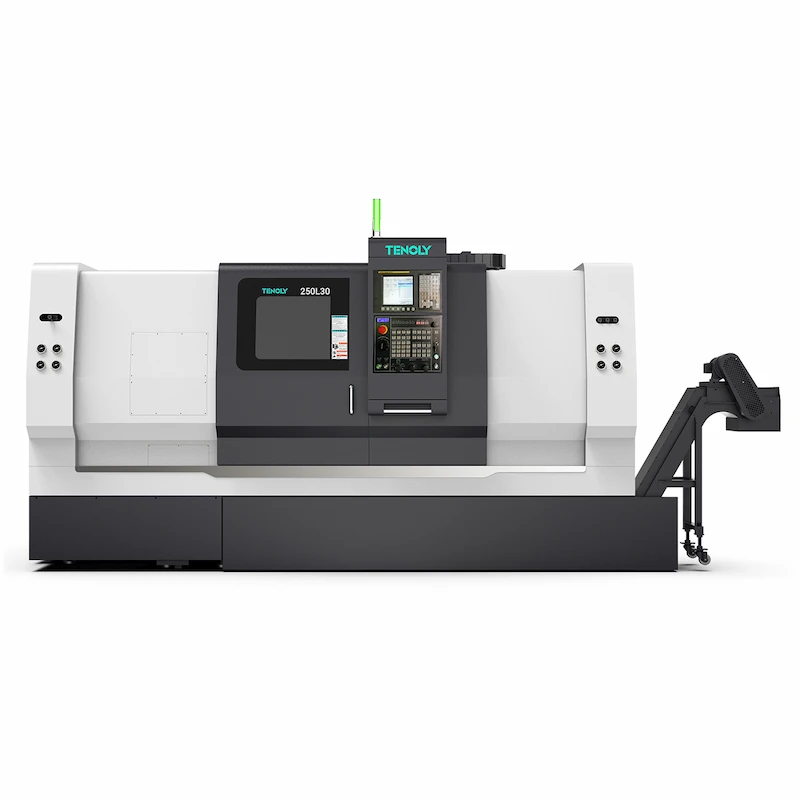
| Weight Capacity | The go-to choice for ultra-heavy machining (typically >20,000 kg). The workpiece weight presses straight down into the floor, offering the best possible gravity support. | Best for medium-to-heavy loads (typically <15,000 kg). While some high-end brands use thickened cast iron to build heavy-duty slant beds, the capacity is still structurally limited by the incline angle. |
| Chip Management | Less efficient. Hot chips tend to pile up right under the workpiece, requiring complex internal scrapers or manual raking to clear the bed. | Gravity-assisted. Hot chips slide straight down the slope into the conveyor, keeping the work area clear and ensuring uninterrupted production. |
| Operator Access | Very wide footprint. Operators have to lean in way too far over the bed when setups, tool settings, or manual measurements are needed. | More compact depth. The operator stands much closer to the spindle centerline, giving them a better view and making loading or measuring parts much easier on their back. |
| Rigidity Focus | Engineered for maximum vertical load support. | Engineered for superior torsional rigidity (resisting twisting forces caused by heavy cutting). |
Reduce Unnecessary Re-Clamping
If your shaft components require additional operations such as keyway machining, end-face drilling, or off-center milling, it is advisable to consider a machine with multi-tasking capabilities. Hoisting a 10-ton shaft off a lathe and transferring it to a floor-type boring and milling machine—only to repeat the alignment and tool-setting processes—not only wastes valuable time but also introduces cumulative positional errors caused by re-clamping.
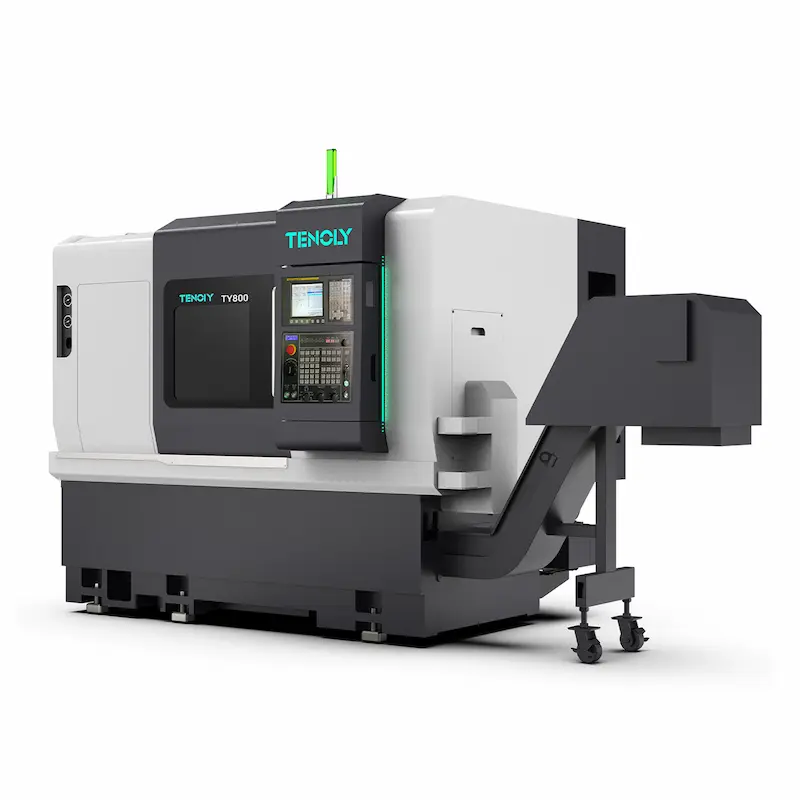
The optimal solution is to choose a slant-bed turning center equipped with a high-rigidity Y-axis and live tooling. This allows complex, multi-feature parts to be fully machined in a single setup, streamlining a traditionally lengthy, multi-stage workflow into a highly efficient, integrated machining process.
Step 4: Reliability Verification of the CNC System and Auxiliary Configurations.
When rotating massive steel components under high torque, any unexpected tool breakage can lead to a serious equipment accident—damaging not only the workpiece but also compromising the precision of the high-value spindle.
- Control System Response Speed: Opt for industry-standard CNC systems with significant market share, such as the FANUC Oi-TF, Siemens 828D, or Heidenhain 640. It is essential to equip the system with advanced tool load monitoring capabilities. If a deep-hole boring tool suddenly strikes a hard spot or an inclusion deep within the workpiece, the system must detect the resulting surge in current and load within microseconds and instantly retract the tool, thereby protecting both the tool and the spindle before the insert shatters.
- Chip Removal and Cooling for High-Output Operations: Heavy-duty roughing generates large volumes of long, stringy chips in a short period. Standard chip collection bins can lead to chip accumulation that disrupts the machining process. Therefore, the machine should be equipped with a high-torque hinged-belt chip conveyor and a high-pressure cooling system to ensure effective chip breaking and to thoroughly flush out chips accumulating inside the deep hole.
Step 5: Pre-inspection Checklist for Heavy-Duty Lathe Procurement
Purchasing a heavy-duty lathe requires more than just relying on brochures or sales promises. Before signing a commercial contract, it is advisable to carry out the following three technical verifications:
- Assess the manufacturer’s after-sales technical capabilities: Conduct an on-site visit to the equipment manufacturer’s factory or observe actual applications at the sites of other customers using similar heavy-duty machines. Focus on evaluating the after-sales technical team: Do they possess experience in resolving mechanical failures in large, heavy-load equipment? What is their response time in the event of a gearbox or tailstock malfunction? Are critical spare parts stocked locally?
- Mandate test cutting with extreme-specification workpieces: Before the machine leaves the factory, require a test cut using a typical part that represents the highest level of machining difficulty in your workshop (or a test piece that fully simulates extreme cutting forces). Base the assessment on concrete inspection data: for example, under actual cutting stress, is the runout over a full length of 2,000 mm effectively controlled to within 0.005 mm? Can the process capability index consistently exceed 1.33?
- Implement high-specification foundation engineering: Heavy-duty equipment of this scale imposes strict requirements on the installation foundation. You must obtain detailed foundation drawings from the manufacturer in advance and allocate sufficient time and budget for excavating a deep pit, installing reinforcement, and pouring high-grade concrete. An independent foundation designed to resist vibration and settlement is essential to ensure the machine maintains bed integrity and consistent precision throughout its long-term operation.
Summary of Key Technical Points for the Procurement Decision-Making Team
- Prioritize torque specifications over rotational speed: Focus on evaluating low-speed output torque and mechanical gearbox transmission efficiency rather than maximum no-load speed. High torque at low speeds is essential for maintaining efficiency during heavy-turn rough machining.
- Select the geometric configuration based on the process workflow: If the task involves extreme rough turning of massive shafts, a flat-bed design ensures the necessary load-bearing capacity; however, if the goal is multi-process integration, automated chip removal, and high overall efficiency, a slant-bed turning center equipped with live tooling offers a better long-term return on investment.
- Chip management and monitoring systems are critical auxiliaries: Without timely chip evacuation or tool overload protection, the machine will frequently trigger error shutdowns during operation due to overloads or chip entanglement.
- Foundation rigidity is just as important as machine rigidity: Budget for workshop foundation modifications early in the project. The overall machining rigidity of heavy-duty equipment depends equally on the machine’s cast-iron structure and the quality of the factory floor foundation.
Summary Recommendations
Prioritize strict adherence to specifications for low-speed, high-torque performance and integral cast-iron box-way structures; mandate extreme-load test cuts and the construction of deep foundations; and avoid the blind pursuit of high spindle speeds.