Skip to content

In the competitive landscape of precision manufacturing, turning and milling technology was once considered the ultimate means of improving efficiency. However, as aerospace, medical engineering, and high-end semiconductor components evolve towards “fully integrated, high-precision, and complex geometry,” traditional 3+2 axis or fixed-angle MCH equipment is gradually revealing its technological limitations.
The real challenge facing manufacturers is: under what production conditions is upgrading from standard MCH to 5-axis machining no longer a “nice-to-have,” but an inevitable strategic decision?
This article will deeply analyze the triggering conditions for this technological leap from three dimensions: process chain shortening, turning dynamics optimization, and business profitability models.
1. Precision Bottleneck: The Physical Limit of Cumulative Clamping Errors
In B2B precision machining, tolerance requirements are often not limited to dimensions, but are more reflected in geometric tolerances, such as coaxiality, symmetry, and positional accuracy.
Trigger Signal for Upgrade
When your part manufacturing process involves more than three repeated setups, and the yield rate is unstable due to the impact of edge re-finding and tool setting errors, upgrading is imperative.
Traditional Pain Points: Even the most skilled technicians struggle to completely eliminate micron-level coordinate drift during secondary clamping. For parts with tilted features or spatially intersecting holes, multiple positioning operations exponentially increase accuracy risks.
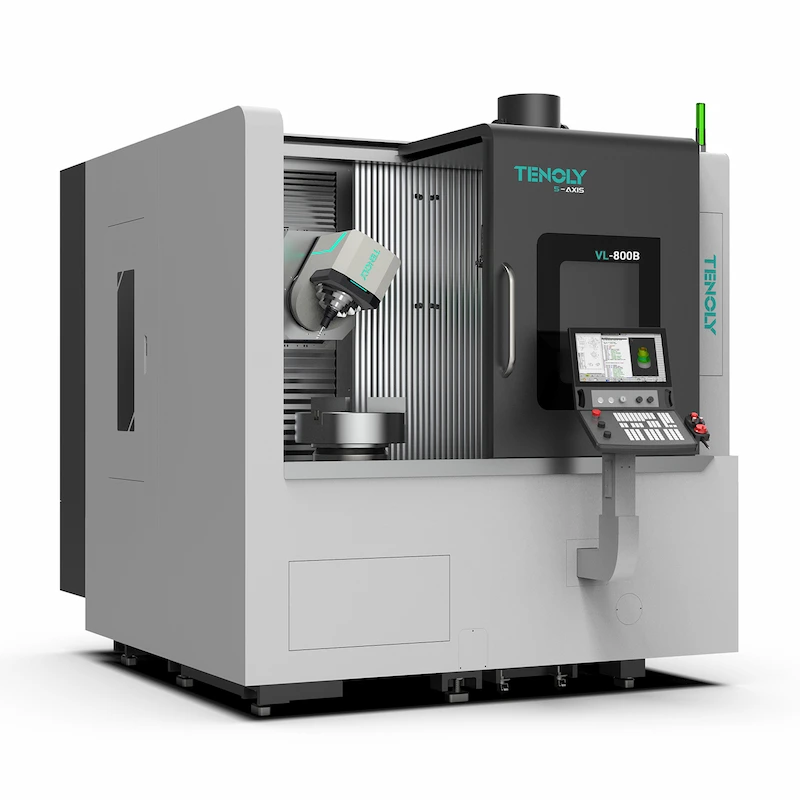
5-Axis Simultaneous Solution: Through the coordinated movement of the B-axis and C-axis, the 5-axis milling and turning center achieves “single clamping, all-around machining.” This “one-machine-completes-the-workpiece” mode fundamentally eliminates datum offsets caused by station transitions, ensuring positional accuracy between complex features.
2. Turning Vector Optimization: Solving the Drawbacks of “Long Tool Machining”
When machining deep-cavity parts or parts with complex chamfers, fixed-angle machine tools are often limited by spatial interference, necessitating the use of long overhanging tools.
Process Feature Comparison
Fixed-Axis Machining: To avoid workpiece interference, the tool must be lengthened. Long tools mean reduced rigidity, making them prone to high-frequency chatter, which not only limits feed rate but also severely shortens tool tip life and can even cause irreversible chatter marks on the workpiece surface.
5-axis simultaneous machining: With 5-axis simultaneous machining, the CNC machine tool can adjust the turning vector of the tool relative to the workpiece surface in real time. This means you can use shorter, more rigid standard tools to reach deeper areas for efficient turning.
Results-oriented: This not only significantly improves surface finish (Ra value) and reduces subsequent manual grinding processes, but also directly shortens the cycle time per piece by increasing the feed per tooth.
3. The Inevitability of Addressing Complex Surfaces
In modern industrial design, the surfaces of fluid dynamic components (such as impellers and guide vanes) and biomimetic parts (such as artificial joints) are non-linear and continuously changing.
Upgrade Decision Criteria
If complex surface machining accounts for more than 20% of your current business and you are still using 3-axis interpolation or segmented machining:
Surface Quality: The “staircase effect” produced by traditional methods requires extremely long post-processing times.
Turning Efficiency: 5-axis simultaneous machining ensures that the tool is always in contact with the workpiece at the optimal turning point, maintaining a constant surface velocity.
This “continuous processing capability” is an essential technical qualification for entering the supply chains of Boeing, Airbus, or high-end semiconductors.
4. Business Dimension: From “Labor Costs” to “System Efficiency”
On the balance sheets of B2B manufacturing companies, equipment premiums are often offset by direct labor savings and site optimization.
Restructuring Labor Costs: Finding a skilled fitter proficient in multiple clamping operations, fixture design, and alignment is far more expensive than operating a five-axis machine tool with an intelligent programming environment.
Work-in-Process Optimization: In traditional processes, a part may take 7-10 days to cycle between lathes, milling machines, and wire EDM. A 5-axis milling and turning machine can reduce this cycle to a few hours.
Flexible Manufacturing: Facing the market trend of “small batches, multiple varieties,” five-axis equipment, by reducing reliance on specialized fixtures, reduces changeover time by more than 50% compared to traditional equipment.
5. When is the Ideal Time to Invest in 5-Axis Machine?
As a decision-maker, you can refer to the following capability upgrade indicators:
Scrap Rate Analysis: If over 40% of defective products are due to “positioning errors” or “damage from secondary clamping.”
Order Response Speed: Are customers switching to competitors with integrated machining capabilities due to your lengthy production processes?
Technical Barriers: Are you facing low-price competition for simple parts and urgently need to enter the high-value-added precision parts market?
Conclusion
The move from mill-turning to 5-axis machining is not simply about adding two motion axes, but a shift in thinking from “process stacking” to “process integration.” Although the initial equipment investment is higher, its comprehensive performance in terms of accuracy consistency, tooling cost control, and shortened delivery cycle often demonstrates a very high return on investment within 18-24 months.
If you plan to optimize your current production pipeline, it is recommended to start with a feasibility analysis of machining core, high-difficulty parts, and gradually evaluate the combined value of automation and 5-axis machining.