Skip to content

As core equipment within the metalworking industry, CNC lathes and manual lathes represent two fundamentally different approaches to manufacturing. This article will provide a comprehensive, multifaceted breakdown of these machine tools, revealing the true nature and capabilities of these two powerful machining assets.

I. Core Positioning
Whether a CNC lathe or a manual lathe, the fundamental turning principles—specifically the removal of metal material and the machining of rotational parts—remain consistent. However, the core distinctions between the two are significant:
Manual lathe relies on the operator to manually adjust handwheels and control the feed rate based on experience; it is a highly flexible machine tool designed to meet the needs of single-piece repair work, emergency machining, and tooling fabrication.
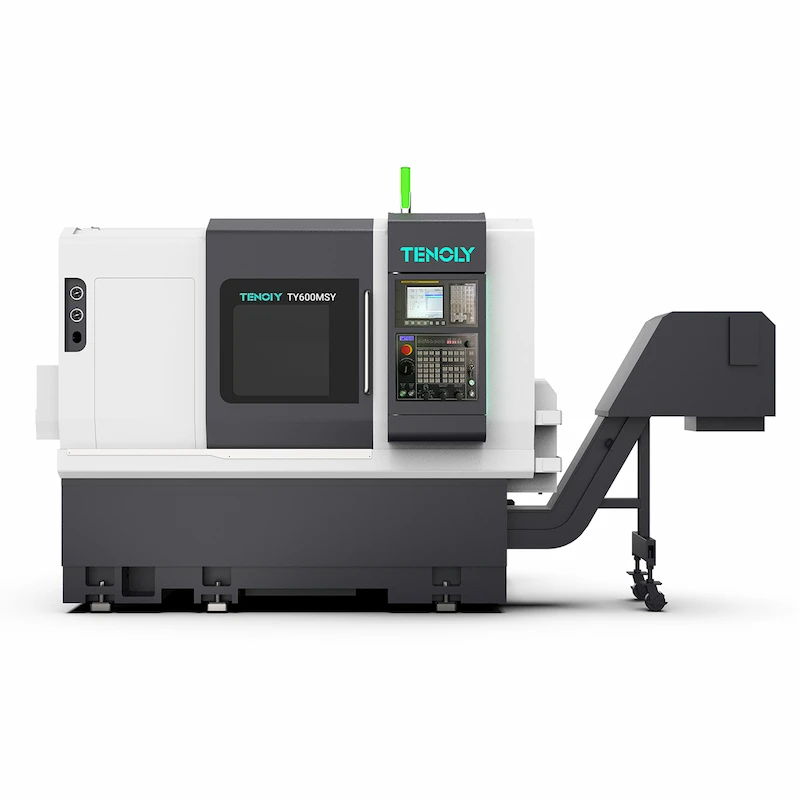
CNC lathe utilizes digital programs to drive servo systems and execute multi-axis coordinated control; it is a highly automated machine tool designed to meet the demands of machining complex contours, achieving high precision, and facilitating mass production.
| Dimension | Manual Lathe | CNC Lathe |
| Core Positioning | Ultimate flexibility and low-cost single-piece machining | High precision, high efficiency, and mass production of complex parts |
| Core Driving Force | Relies on the operator’s experience, hand-feel, and skill (Brain + Muscle) | Relies on digital programs and servo motor drives (Computer + Mechanics) |
| Machining Objects | Simple parts, urgent repair jobs, single-piece fittings, and jigs/fixtures | Batch components, high-precision parts, and non-standard parts with complex surface contours |
| Production Setup | Zero programming time, immediate machining upon clamping, extremely fast adjustment | Requires programming, tool setting, and simulation debugging; long setup time for the first piece |
II. Pre-Procurement Self-Assessment
Before planning your equipment budget, your company must clearly define its specific production context. Based on varying production scales and order characteristics, the dividing line between the two options is remarkably clear:
1. Companies Suited for Purchasing CNC Lathes:
- Medium-to-Large-Scale OEM/ODM Batch Manufacturers: Characterized by high order volumes—often involving hundreds or thousands of parts per batch—with relatively standardized part geometries, requiring equipment capable of continuous 24-hour operation (including unmanned overnight production).
- High-Precision Industry Suppliers: Supply chain partners serving sectors such as automotive (crankshafts), medical devices (bone screws), and aerospace (fasteners), where tolerance requirements are strictly controlled at the micron level.
- Companies Facing Labor Shortages and Cost Pressures: Located in regions experiencing a shortage of experienced, skilled machinists and persistently high labor costs, these companies seek to rely on standardized procedures to reduce their dependence on “high-paid senior technicians.”
2. Companies Suited for Purchasing Manual Lathes:
- Prototyping Centers and R&D Laboratories: Primarily engaged in the development and trial production of one-off prototypes, where design dimensions frequently require on-the-fly adjustments during the testing process.
- Heavy Industry and On-Site Repair Facilities: Examples include mining machinery repair, the restoration of large marine shafts, and the on-site refurbishment of oilfield pipe threads. Such work typically involves repairing unique, damaged components and cannot be standardized into repeatable machine code.
- Vocational Technical Schools and Startup Workshops: Possessing limited initial capital budgets, these entities utilize the equipment primarily for teaching fundamental machining skills or handling miscellaneous, small-scale repair jobs for external clients.
Avoiding Pitfalls: > A common reason companies purchase the wrong equipment is that they overlook “changeover time.” If your factory receives daily orders involving the repair of uniquely shaped, damaged shafts—requiring you to switch between a dozen different workpieces in a single day—investing in a CNC lathe will prove exhausting. You might spend half the day writing programs, setting tool offsets, and adjusting fixtures, while the veteran manual lathe operator next door can clamp the workpiece in just five minutes, simply crank the turning tool into position, and start machining immediately.
III. Comparison of Typical Application Scenarios

To provide a more intuitive understanding, let’s examine two of the most typical daily workshop scenarios:
Scenario A: Batch Machining of Difficult-to-Cut Materials (e.g., Stainless Steel 316L or Titanium Alloys)
When dealing with materials that are highly prone to work hardening, possess high toughness, and generate tangled chips, a CNC lathe is the undisputed champion. This is because a CNC machine can deliver an extremely constant turning surface speed (CSS) and can be equipped with a high-pressure internal coolant system (exceeding 70 bar). This system directs turning fluid precisely onto the contact point between the tool tip and the chip, forcibly breaking the chips and rapidly dissipating heat—thereby extending tool life several-fold. Conversely, if one attempts to turn stainless steel on a manual lathe, even a slight hesitation or inconsistency in the manual feed rate will cause the tool tip to instantly wear down or chip upon contact with the work-hardened surface layer.
Scenario B: Emergency Shutdown Recovery (e.g., Flange Leakage at a Chemical Plant)
It is 2:00 AM. A production line at a chemical plant has been forced to shut down because the sealing groove on a custom-made flange has been damaged. Every hour of downtime translates into financial losses amounting to tens of thousands of dollars.
In such a moment, the manual lathe becomes a lifesaver. A machinist simply mounts the damaged flange onto the chuck, relies on years of accumulated experience to visually assess the situation, and turns the feed handwheel; within minutes, the sealing groove is successfully repaired, and the equipment is immediately back in operation. At a time like this, if you were to attempt to fire up a CNC machine—searching for blueprints, creating a 3D model, and generating G-code—the opportunity would have long since passed.
IV. In-Depth Analysis of Technical Specifications: Precision, Rigidity, and Spindle
When making a purchase, do not be swayed solely by the impressive figures listed in the sales brochure; instead, we must focus on the physical structural elements that have a decisive impact on machining performance:
1. Geometric Precision and Tolerance Control
- Manual Lathes: The upper limit of their machining precision typically falls within the range of ±0.02 mm to ±0.05 mm. Why? Because they rely on mechanical lead screw transmissions, which inevitably introduce a certain amount of backlash (reverse clearance). Furthermore, the final dimensional readings depend on the operator’s visual interpretation of the graduated dials, making some degree of human error unavoidable.
- CNC Lathes: By utilizing preloaded double-nut ball screws and a fully closed-loop servo control system, these machines can effortlessly achieve a positioning accuracy of ±0.003 mm. Even if the lead screw develops a minute amount of backlash after prolonged use, the system can directly apply micron-level digital compensation via internal parameters, ensuring that the dimensions of the very first part produced match those of the 1,000th part with absolute precision.
2. Machine Tool Rigidity: Why is a 30° Slant Bed Superior?
If you observe most modern CNC lathes, you will notice that their beds typically feature a 30° or 45° slant design, whereas older manual lathes utilize flat beds. The slant-bed design is not merely for aesthetic appeal; it significantly shortens the moment arm—the distance from the tool post to the bed base—thereby boosting mechanical rigidity by over 30% compared to flat-bed designs. More importantly, the scorching-hot metal chips generated during high-speed turning slide directly down the slanted surface into a chip cart located at the base, preventing them from accumulating on the guide rails and causing abrasive wear that would compromise precision.
V. Craftsmanship Heritage: What Determines Whether a Lathe Lasts 3 Years or 10?
Many buyers ask me: “Why are the CNC lathes from some small workshops so cheap—almost as if they were selling scrap iron—while yours are somewhat more expensive?” The answer lies in the fact that the machine tool is the “Mother of Industry”; while they may all appear to be nothing more than stainless steel enclosures on the outside, the underlying craftsmanship and internal quality can be worlds apart. The creation of a truly exceptional lathe involves undergoing a series of rigorous processes—often invisible to the untrained eye—that serve to temper and refine the machine:
- Natural Aging Treatment: Our machine tool castings are made from high-strength Meehanite cast iron; they are absolutely *not* sent directly from the foundry to the milling machine for processing immediately after casting. Instead, they must undergo a natural aging process lasting 6 to 12 months in an open-air environment—exposed to wind, rain, and sunlight—allowing natural temperature fluctuations to thoroughly release any internal residual stresses. Only through this process can we ensure that the machine bed remains free of even minute deformations, allowing the lathe to serve reliably in your facility for 8, 10, or even more years.
- Ultra-Audio Frequency Quenching: The surfaces of the guide rails undergo a deep-quenching heat treatment, achieving a hardness level of HRC 50 or higher. This ensures that—even under high-intensity machining operations or contact with abrasive metal chips—the guide rails will not easily develop burrs or surface scratches.
- Precision Hand Scraping: No matter how advanced modern industrial technology becomes, there remain certain tasks that simply cannot be replicated or replaced by machines. The contact surfaces of our machine tool guide rails and sliders are meticulously hand-scraped—one stroke at a time—by master craftsmen with over 15 years of experience. Each square inch must feature at least 25 distinct micro-contact points. When combined, these tiny points effectively trap the lubricating oil between the sliding surfaces, forming a flawless oil film that allows the machine tool’s movement to glide as smoothly as a hot knife through butter.
VI. ROI and Hidden Risk Mitigation

Purchasing equipment is a business decision that requires careful financial calculation:
1. A Clear and Tangible Economic Analysis
Let’s assume you have secured a long-term contract to machine a batch of standard automotive stepped shafts (a single batch of 2,000 units):
Using a Manual Lathe: You would need to hire a highly experienced, senior-level lathe operator. He might take approximately 25 minutes to turn a single part. Furthermore, humans are highly susceptible to fatigue during prolonged, high-intensity, repetitive labor; a momentary lapse in concentration—a mere tremor of the hand—could easily result in a scrapped part. Consequently, the overall delivery timeline would be significantly extended.
Using a CNC Lathe: Once the machining program is properly set up, a standard worker—perhaps a recent vocational school graduate earning a modest monthly wage—can single-handedly supervise three machines simultaneously. The processing time per unit is slashed directly to just 4 minutes. Provided the raw materials are sound, the scrap rate—controlled by the automated system—is virtually zero. When factoring in the savings on labor and material costs, as well as the boost in efficiency, most factories can recoup the entire cost of the machine within 10 to 14 months.
2. Hidden Risks That Demand Prior Warning
- Inferior CNC Control Systems: The market is rife with obscure, off-brand CNC control systems. After just one or two years of operation, these systems often suffer from inexplicable crashes or data loss (such as lost parameters); worse yet, if the manufacturer goes out of business, you are left with absolutely no after-sales support. All CNC machines shipped from our factory are uniformly equipped with world-class, Tier-1 control systems (such as Fanuc or Siemens). These systems come with a global warranty, ensuring that no matter where you are located, you can easily find a local service engineer to provide support.
- “Machine Crashes” by Novices: During rapid traverse movements (G00 commands), CNC machines move at extremely high speeds—typically reaching up to 30 meters per minute. If an operator makes a programming error or incorrectly sets the tool offsets, pressing the “Start” button can result in the tool turret slamming into the chuck with the force of a cannonball. To address this, our CNC system comes equipped with a comprehensive, fully simulated 3D anti-collision feature. Furthermore, upon delivery and installation of the machine, we provide your operators with complete online training on safe operation procedures.