Skip to content

If you are planning to purchase new CNC machine tools to boost your production capacity but are torn between a basic lathe and a CNC turning center, it is crucial to make your selection based on your specific part processing requirements. Blindly purchasing equipment can lead to a loss of precision caused by frequent workpiece transfers, or result in underutilized machine capabilities. As experts in domestic machine tool manufacturing, we will break down the practical differences between these two types of machines to help you choose the production tool best suited to your needs.

Do you assume that a CNC lathe and a CNC turning center are essentially the same machine?
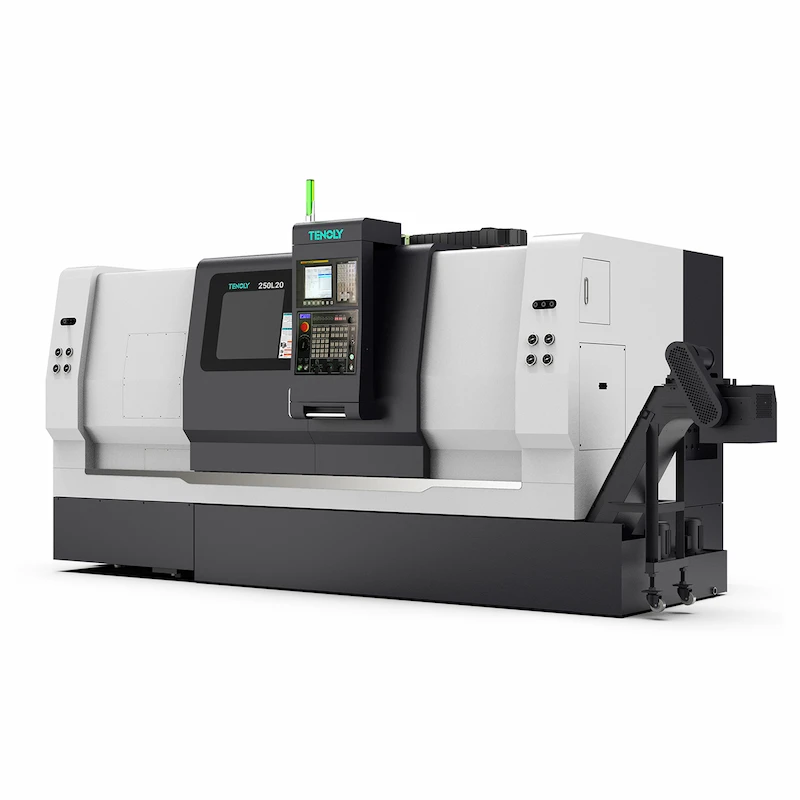
They are not. A CNC lathe is primarily dedicated to “rotational machining.” If your parts consist entirely of standard cylinders or cones—requiring only surface turning and thread turning—a standard lathe is the ideal choice; it offers high stability and provides the fastest return on investment. A CNC turning center, conversely, acts as a “compact multi-tasking machining line” that integrates turning, drilling, milling, and tapping operations. It does more than just rotate the workpiece; utilizing live tooling, it can directly execute complex geometric features on the side or face of the part.
I. In-Depth Technical Comparison
Number of Axes:
CNC Lathe: Typically features 2-axis (X/Z) simultaneous control. The workpiece rotates while the turning tool moves.
CNC Turning Center: Possesses at least 3 axes or more. The most critical distinction is the introduction of the C-axis and Y-axis.
Machining Capabilities:
CNC Lathe: Limited to turning operations on cylindrical surfaces and thread turning.
CNC Turning Center: Capable of performing off-center drilling, slot milling, and surface milling on the face or cylindrical surface of a part, thereby enabling “multi-purpose machining” on a single machine.
Live Tool Turret:
Standard lathes utilize a static tool turret, where the turning tools themselves remain stationary. CNC turning centers, however, are equipped with a live tool turret; this allows them to directly execute tasks typically reserved for a “machining center“—such as milling flats or drilling angled holes—all within the lathe environment.
Bed Structure and Rigidity Distribution:
CNC turning centers commonly employ a 30° or 45° slant-bed design. This design lowers the machining’s center of gravity, enabling it to effectively absorb vibrations generated by high-speed machining operations using live tooling. When processing high-precision orders, the surface finish and geometric tolerances achieved by a slant-bed machine significantly outperform those of a flat-bed lathe.
II. Production Efficiency
Traditional lathes rely on conventional machining processes, requiring a skilled operator to remove the workpiece once turning is complete and transfer it to a separate machine tool for subsequent operations—such as drilling or milling—during which the operator must perform a second alignment and clamping procedure. In contrast, a CNC turning center can complete all these operations in a single clamping setup. Reducing the number of clamping cycles not only saves on labor costs but, more importantly, eliminates the cumulative tolerances that typically result from secondary alignment procedures. Consequently, the yield rate improves from 90% to 99%, thereby significantly widening profit margins.

III. Selection Guide
| Machining Needs | Recommended Equipment | Decision Rationale |
| Mass production of simple-shaped shafts/discs | CNC Lathe | Short investment recovery period, simple maintenance, and rapid ROI. |
| High-precision complex parts with milling slots/side holes | CNC Turning Center | Ensures strict tolerances and reduces costs associated with multi-process transfers. |
| Small-batch, diverse, and tight-deadline orders | CNC Turning Center | Fast changeover, flexible response, and ideal for agile manufacturing models. |
| Seeking “Unattended” automated integration | Turning Center with Sub-spindle | Automatic handoff between spindles for front/back machining, truly liberating frontline labor. |
IV. Industry Trends
At the CCMT 2026 exhibition, we observed that purely 2-axis lathes are increasingly being relegated to the entry-level market, while turning centers—equipped with multi-functional machining capabilities—are becoming the standard fixture in factories worldwide. The slant-bed structure, by virtue of its inherent advantages in chip evacuation and compatibility with robotic arms, has emerged as the preferred solution for automated workshops.