Skip to content

The differential housing typically refers to the outer shell of an automotive differential case, housing and protecting the differential gear assembly. It transmits power, withstands loads and vibrations from the road and vehicle body, and provides necessary alignment and support for the internal gears.
The stability and machining accuracy of the differential housing directly impact the transmission performance, durability, and assembly reliability of the differential, thus requiring high attention in design, material selection, manufacturing processes, and quality control.

Differential Housing Application Cases and Solutions
We previously had a customer with stringent requirements for external diameter, roundness, taper, and coaxiality between the inner and outer diameters of both ends. The targets, based on CMM measurement, were as follows: external roundness within 0.005 mm, taper within 0.002, and coaxiality within 0.015. To meet these demands, the Tenoly technical team achieved significant improvements through customized solutions, including the following key points:
① Optimization of a customized reinforced tailstock and guideway: Targeting the support needs of long workpieces, this system improves rigidity and stability, significantly reducing workpiece runout and enhancing geometric stability. Compared to conventional tailstocks, this system offers advantages in cost, complexity, and automation efficiency. System optimization also enables excellent resonant control of the spindle and toolpath.
② Precision Control of Guideway and Spindle Coaxiality: Through a customized guideway and spindle alignment, installation, and commissioning process, coaxiality and height control are improved to approximately 0.002 mm, significantly reducing geometric error transmission during machining.
③ On-site Application of the 210M Series CNC Lathe: Using the 210M as the core platform, combined with a reinforced tailstock, customized guideways, and precise alignment control, it enables high-precision machining to meet stringent tolerances in a single clamping cycle. Key parameters such as maximum machining diameter, working length, spindle speed, and torque, and tailstock and split-spindle configurations provide the hardware support necessary to achieve high precision.
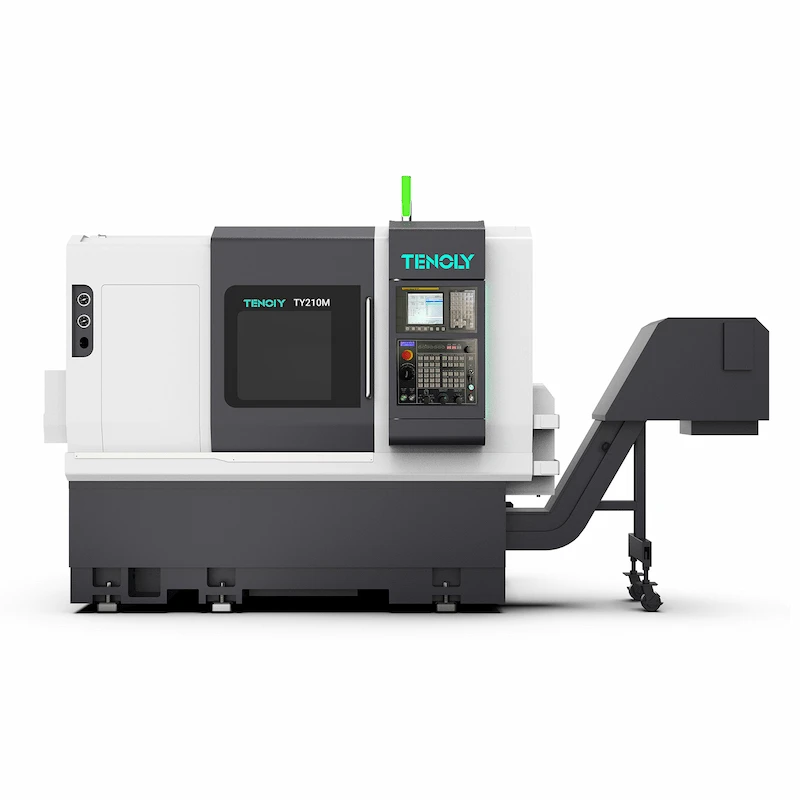
Our Recommended 210M CNC Lathe
The 210M CNC lathe, with its high rigidity, stability, and controllability, has become a core platform for differential shell machining. Key features include:
① Structure and Parameters: The 210M’s overall structural design emphasizes high rigidity and stability, featuring a powerful spindle, an optimized tailstock and guideway combination, and an efficient tool changing system. Typical parameters such as spindle speed, torque distribution, feed rate, and positioning accuracy are designed to achieve high repeatability and precision in multi-axis machining. Combining it with a customized tailstock and guideway significantly improves runout control and coaxiality during long-part machining.
② Advantages and Applications: Its high rigidity and stability give the 210M a clear advantage in complex contours, long parts, and high-precision machining, particularly in differential shell machining in the automotive, aerospace, and energy industries. When combined with a customized tailstock and guideway, it achieves higher repeatability and lower distortion errors, ensuring improved final inspection pass rates and increased production efficiency. Industry case studies demonstrate that the 210M performs well in achieving high-precision targets such as 0.005mm roundness and 0.002mm taper.
③ Structural Element Overview: This machine tool typically includes a highly rigid machine bed, a sophisticated spindle assembly, a tool changer (such as the BMT65), an optimized combination of tailstock and guideways, and an efficient CNC control system. Customized design of core components enables continuous improvement in spindle coaxiality, height control, and overall thermal stability, providing reliable support for high-precision processes.
Quality Control System: Integrated management from design to after-sales service
High-quality differential shell machining requires not only advanced equipment but also a comprehensive quality management system to ensure long-term, stable output. Key aspects include:
① Design and Process Control: Critical process parameters are refined during the product design phase to ensure design and process rationality, identify potential machining challenges in advance, and develop strategies to address them. For long parts and high-precision targets, the accuracy of process parameters directly determines the consistency of subsequent machining.
② Source Control of Raw Materials and Components: Strictly trace the quality of key materials and components, establish material grades and inspection standards, and ensure that every piece of material entering the processing line meets specifications, thereby reducing sources of deformation and assembly errors.
③ Process Standardization and On-site Control: Standardized assembly operations and process monitoring ensure consistent execution of key steps, improving repeatability and yield. Mid-term inspections and quality monitoring during the process enable early detection of process anomalies, facilitating rapid correction.
④ Final Inspection and Third-Party Quality Inspection before Shipment: Multi-dimensional assessments, including geometric accuracy testing, positioning, and repeatability accuracy, actual sample processing, and safety performance, ensure that the machine tool meets required processing capabilities and safety requirements under actual operating conditions. Introducing third-party quality inspections helps enhance independence and trust, thereby strengthening customer confidence.
⑤ Closed-Loop Management and Continuous Improvement: Establish a comprehensive quality record, compile after-sales feedback, and promote continuous improvement of design and process, forming a traceable and sustainably optimized quality system.
Summary
By leveraging the 210M CNC lathe as the core platform, combined with a customized reinforced tailstock, optimized guideways, and high-precision alignment control, we have consistently met critical tolerances for external roundness, taper, and coaxiality, establishing an integrated quality closed loop from design to after-sales service. This solution has withstood the test of high-standard tolerances in actual projects, significantly improving production capacity, yield rate, and customer trust, becoming a practical solution for companies pursuing high-end differential shell processing.