Skip to content

In the field of precision machining, the production of cartridge cases has long served as a “touchstone” for gauging a factory’s level of automation.
Recently, we custom-engineered an automated production line for processing cartridge cases on behalf of a renowned industrial client. The challenges this client initially faced were highly representative of the industry: thin-walled products prone to deformation, a high length-to-diameter ratio, extremely stringent precision requirements, and massive market demand (requiring an annual output of 1.3 million units).
If you, too, are grappling with the challenge of balancing high production output with low operational costs, this in-depth analysis of our solution may offer you some fresh perspectives.
I. Project Overview
1. Processing Requirements
- Material: 15 Steel (SAE 1015), HRC 22–28;
- Production Capacity: 1.3 million pieces/year (based on 300 working days per year, 2 shifts per day, 8 hours per shift);
2. Objectives
- Implement automated loading/unloading and automatic control systems, equipped with industrial robots, machine vision systems, and associated sensors to create a fully automated production environment.
- While ensuring product processing quality, maximizing equipment utilization, boosting production capacity, and achieving a system characterized by minimal human intervention, reduced personnel requirements, and ease of management.
- Establish an intelligent manufacturing production cell that integrates processing equipment, marking devices, and other components via a central control system and an automated logistics system. This involves the deployment of advanced industrial robot systems, sensor networks, automated material handling systems, data acquisition and monitoring systems, and automated material storage units.
- Personnel Requirement: 2 operators per shift.
3. Challenges
■ Thin-walled structure: Highly susceptible to deformation during processing;
■ Tubular parts: Slender geometry makes maintaining dimensional accuracy difficult;
■ Unique positioning requirement: The primary locating feature is situated on the inner wall of the tubular part’s cross-section;
■ Tubular parts processing: Minimize the number of clamping/fixturing operations to ensure processing stability and high part-to-part consistency;
II. Solution
We provided the client with a comprehensive solution ranging from process design to equipment integration. The entire production line occupies an area of approximately 23m x 10m and operates as a “lights-out” factory.
1. “8+2” Flexible Processing Cell
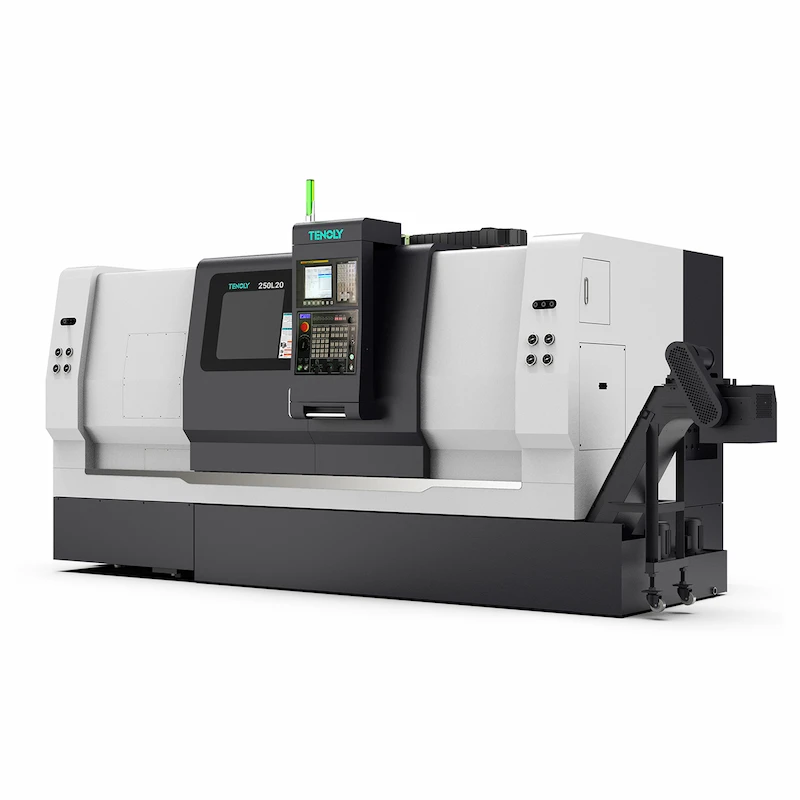
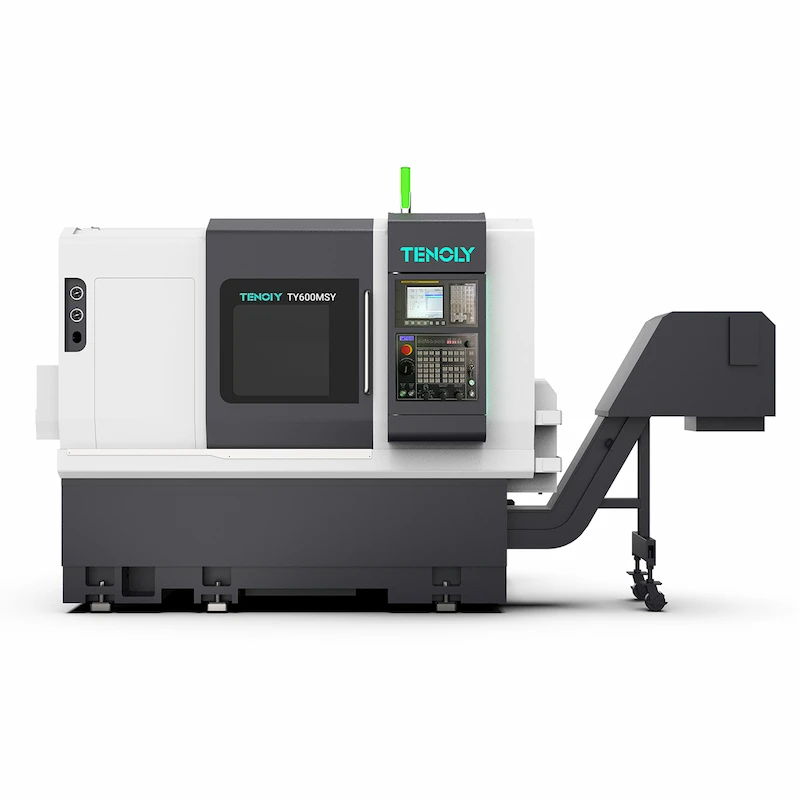
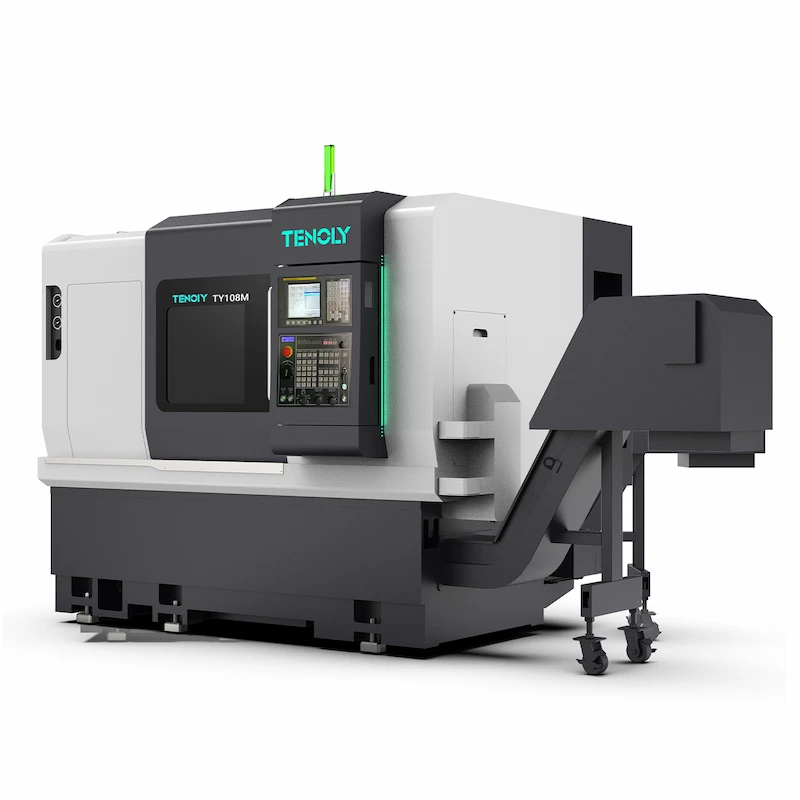
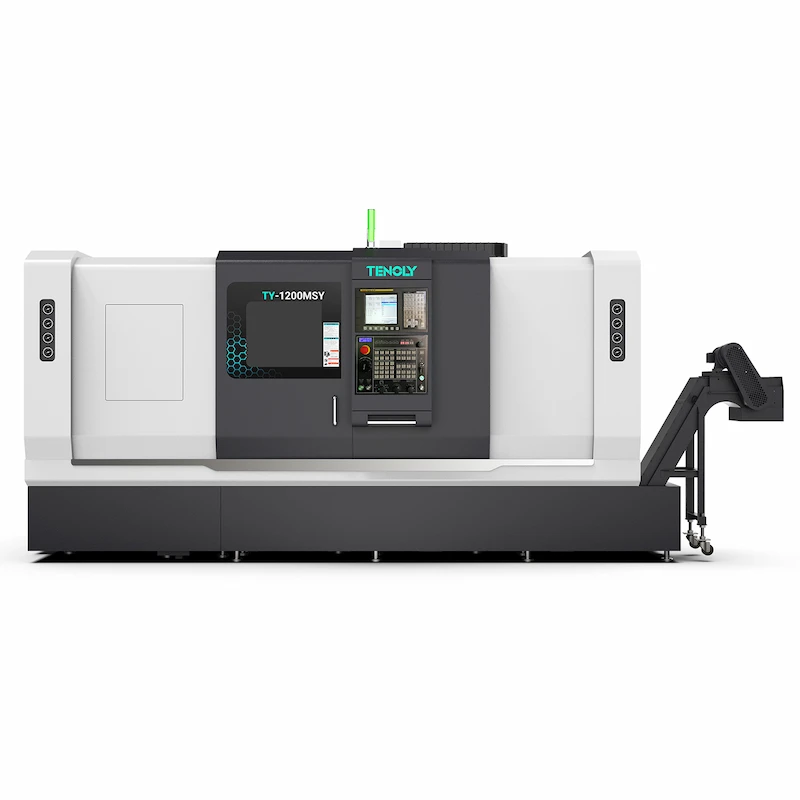
Based on the required process sequence, we configured a lineup of 10 high-performance CNC lathes:
- OP10 Operation (Bottom Processing): Performed by 8 CNC lathes operating in parallel. This is the most complex operation, involving face turning, outer diameter turning, grooving, and fine thread turning. The parallel operation of multiple machines ensures the required throughput for the entire production line.
- OP20 Operation (Cut-off/Finishing): Handled by 2 dedicated lathes responsible for the final finishing stage, ensuring the overall length dimension and the flatness of the cut-off face meet specifications.
2. “Inverted” Robot Gripping System
Unlike traditional side-mounted robot configurations, we adopted an overhead rail-mounted, inverted layout for the robots. This design maximizes floor space savings while providing the robotic manipulators with an expanded operational radius. Equipped with custom-designed rotary pneumatic grippers, the robot can precisely and rapidly transfer workpieces between machine tools, inspection stations, and the double-speed chain conveyor.
3. Intelligent Logistics and In-line Inspection
- Double-Speed Chain Conveyor Line: Acting as the “main artery” of the production line, this dual-layer conveyor—integrated with AGVs—enables the orderly buffering and automated circulation of materials.
- 3D In-line Inspection: Upon completion of machining, a robot transfers the workpieces to an inspection unit for either random sampling or full inspection. External diameters, hole depths, and thread specifications (measured via Go/No-Go gauges) are all automatically measured. Should any dimensional deviation be detected, the system automatically issues a tool compensation command to the machine tool.
III. Advantages of the Solution
- Direct 80% Reduction in Labor Costs: Under traditional models, managing 10 lathes requires a rotating shift of at least five skilled workers. Now, through highly integrated management, only one or two operators per shift are needed to handle line patrols and material replenishment.
- Quality Consistency Surpassing Human Standards: Human operations are inevitably subject to fatigue and error; this automated system, however, ensures that the precision of the very first product matches that of the one-millionth. This significantly reduces material waste caused by high scrap rates.
- Backed by Intelligent Management: The system features tool-life alerts, real-time equipment load monitoring, and production output analytics. When you showcase this highly automated production line to your clients, it serves as the most powerful testament to your factory’s capabilities.
- Environmental and Energy Efficiency Optimization: The centralized chip removal and coolant supply systems not only maintain a clean workshop environment but also—through a turning fluid recycling mechanism—generate substantial annual savings for the client on consumable supplies.
IV. FAQ
Our workpiece specifications change frequently; can the automated line adapt?
Absolutely. Our system supports “flexible changeovers.” By simply swapping out the specialized gripper jaws and loading the corresponding machining program, you can switch production to a different workpiece specification in a very short time.
Does the inverted robot configuration interfere with machine tool maintenance?
Not at all. The inverted overhead rail design is positioned directly above the CNC machine tools, completely clearing the operational and maintenance zones located in front of the machines. This ensures ample space for workers when performing tool changes or routine maintenance.
How is the automatic tool compensation function implemented?
Data collected by online inspection stations undergoes computational analysis; subsequently, the central control system utilizes communication interfaces to update the machine’s tool compensation values in real time. This truly realizes a “simultaneous processing, measurement, and correction” workflow.
If a single machine tool fails, will the entire production line grind to a halt?
No. The system features a “flexible bypass” function. When a specific machine is undergoing maintenance, robots automatically skip that workstation and reroute materials to other machine tools, ensuring uninterrupted production and preventing workflow bottlenecks.
Is it complicated to switch between product specifications?
It is very fast. Thanks to a modular design, the transition is accomplished simply by swapping the robotic grippers and switching the software program. Whether the workpieces are cartridge cases of varying lengths or different materials, production can be rapidly reconfigured to accommodate the change.
V. Conclusion
Investing in automation is not merely a simple case of “replacing humans with machines,” but rather a dimensional upgrade of an enterprise’s production paradigm. The solution we provided to this client not only resolved their precision challenges regarding cartridge case machining but also gave them a decisive competitive edge in terms of production capacity.
If you are facing similar machining challenges involving slender or thin-walled components, we invite you to contact us to receive a professional, customized solution.