Skip to content

Faced with the stringent tolerances required in automotive component manufacturing, you need a superior CNC lathe. This article provides an in-depth analysis of high-performance turning solutions.
I. Why Does Automotive Component Manufacturing Demand So Much From CNC Lathes?
Automotive manufacturing has long been a driving force behind the advancement of engineering technology. Whether producing drive shafts, constant-velocity (CV) joints, brake discs, or high-precision components for new energy vehicle drive motors, the parts involved typically share these characteristics:
- Complex geometries: Examples include shaft components with intricate cam profiles, valve bodies with multi-stepped bores, and pistons with internal oil passages.
- Difficult-to-machine materials: The widespread use of high-strength alloy steels, titanium alloys, stainless steels, and special cast irons places rigorous demands on machine tool rigidity and cutting force capabilities.
- High-volume production and consistency: Automotive assembly lines cannot tolerate assembly tolerance deviations in any single component; therefore, CNC lathes must deliver exceptional repeatability and stability during prolonged, continuous operation.
II. How Do You Select The Right CNC Lathe For Automotive Manufacturing?
With so many CNC machine tools on the market, you should look beyond the price tag and focus on key technical specifications that determine production efficiency and product quality:
1. Structural rigidity and chip evacuation capability
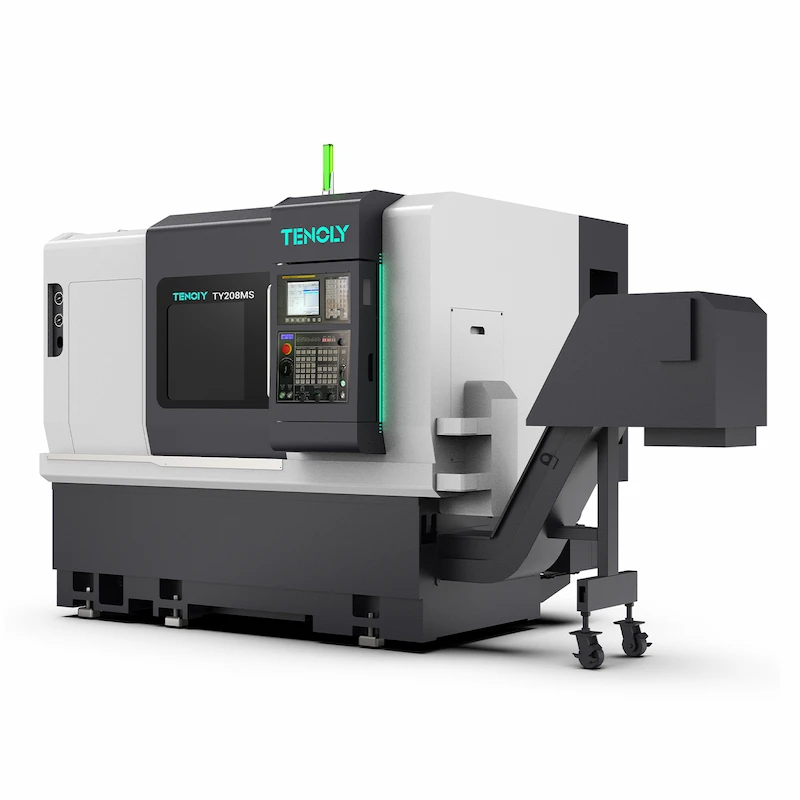
Automotive components are often made of hard metals that generate immense cutting forces—frequently exceeding 10 kN—during machining. Prioritize CNC lathes featuring a 30° or 45° slant-bed design. This structure lowers the machine’s center of gravity and absorbs vibrations, while allowing gravity to guide chips smoothly into the chip conveyor, preventing thermal deformation caused by chip accumulation.
2. Multi-tasking (compound machining) capabilities
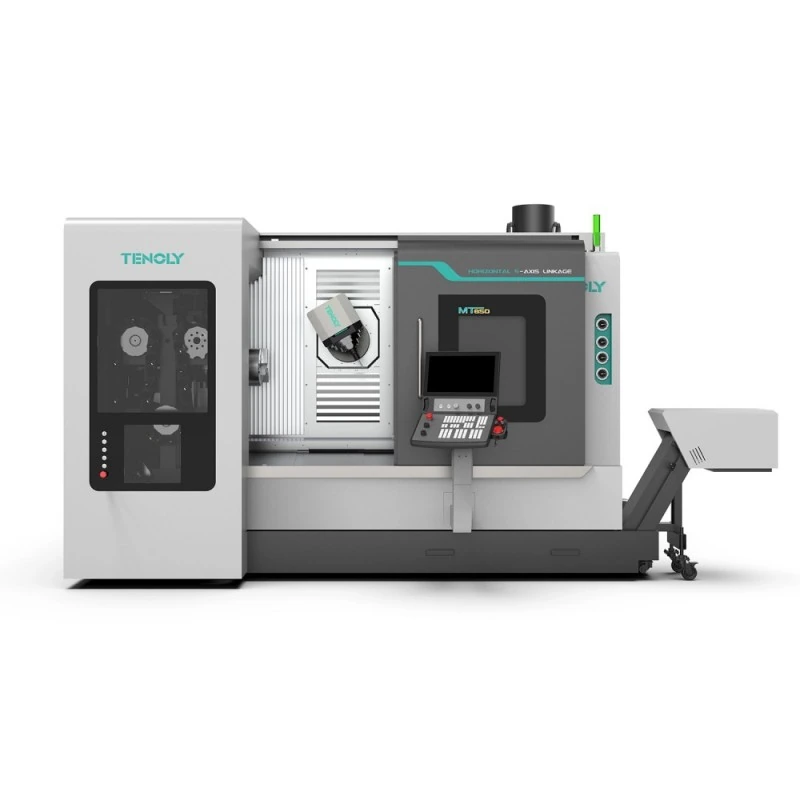
Traditional CNC lathes are primarily designed for “rotational machining” operations such as turning outer diameters, facing, and boring internal holes. However, modern automotive components (such as sensor housings, throttle control shafts, and steering knuckles) often require turning, drilling, face milling, and tapping to be performed on the same workpiece. For complex automotive steering or fuel/transmission components, you need a CNC turning center equipped with a C-axis and a live-tooling turret. This allows you to complete over 95% of machining operations in a single setup, effectively eliminating the cumulative errors associated with multiple clamping operations.
3. Spindle Performance and Automation Integration
In the mass production of automotive parts, cycle time directly determines your profit margins. You should prioritize the spindle’s acceleration time and maximum speed—ideally exceeding 4,000–6,000 rpm. Furthermore, your CNC lathe must seamlessly integrate with automated loading/unloading systems, such as gantry robots or pneumatic automatic chucks; this enables you to boost production efficiency by 30% to over 50% while minimizing manual intervention.
III. Common Application Scenarios and Typical Automotive Components
When a high-performance CNC lathe is deployed in a real-world workshop, it typically plays a pivotal role in the following key production stages:
Powertrain Systems: Machining core components such as crankshafts, camshafts, connecting rods, and engine cylinder liners. High-rigidity turning ensures dimensional stability when cutting high-strength alloy materials, meeting rigorous power transmission requirements.
Steering and Braking Systems: Manufacturing high-precision steering knuckles, hydraulic valve spools, brake discs, and sensor housings. These components are critical to vehicle safety and demand exceptionally high standards for surface finish.
New Energy Vehicle (NEV) Transmission Components: Efficient turning of parts such as electric vehicle motor shafts and reduction gearbox gear blanks. Configurations featuring live-tooling turrets or sub-spindles enable multi-faceted, complex machining in a single operation, drastically shortening the manufacturing cycle for core NEV components.
IV. Conclusion
Selecting a high-performance CNC lathe is a strategic decision that shapes your output for the next decade. Contact us today to receive a customized turning solution tailored to your needs!
FAQ
Yes. Through single-setup or multi-process machining, CNC lathes can efficiently perform external turning, internal boring, and face machining on various automotive shaft parts (such as drive shafts) and disc parts (such as brake discs and flanges).
Yes. Manufacturers can customize spindle power, turret configurations, workholding systems, and automated loading/unloading units based on the specific dimensions, tolerances, and production volume requirements of the parts.
You can contact us for a consultation. We will evaluate your production goals, materials, and facility conditions to recommend the CNC machine tool best suited to your needs.
When integrated with gantry loaders or automatic bar feeders, these systems significantly reduce manual intervention and idle time, boosting production efficiency by 30% to 50% during batch processing.