Skip to content

Introduction: As someone who has worked with machine tools for many years, I often hear business owners say, “5-axis CNC machines are too expensive; I can get the job done just fine by buying three standard lathes instead.” To be honest, in 2026, if you still hold this mindset, you aren’t actually saving money—you’re essentially handing it over to your competitors. Today, let’s skip the complex technical specifications and talk strictly about money: Why does investing in a high-priced five-axis machine tool actually allow you to recoup your entire investment within just 18 months?

I. “One Machine Does the Work of Three”: Not Just a Slogan—It’s Pure Math
Many business owners look at pricing this way: One five-axis machine = $200,000; one standard machine = $60,000. But your calculations are missing a few key details. To manufacture a complex valve body, you actually need to acquire:
- One CNC lathe
- One vertical machining center
- At least two skilled operators
The reality of five-axis integration is this: Raw stock goes in, and a finished product comes out.
- Reduced Handling: Parts no longer have to “tour” the workshop, being shuttled from one machine to another.
- Reduced Setup Time: Every time a part is re-clamped, there is a slight loss of precision. A five-axis machine completes the entire process in a single setup, directly slashing the scrap rate from 5% down to nearly zero.
II. The “Hidden Costs” That Procurement Managers Fear Most: Have You Accounted for These?
| Cost Category | Three ordinary machine tools | A 5-axis turning and milling machine tool |
| Labor Costs (Payroll) | Requires 3 dedicated operators; salary plus social security is a massive drain. | One operator can manage two units; every cent saved on labor is pure profit. |
| Floor Space | Occupies 40 m²; factory rent and utilities are becoming increasingly expensive. | Only 15 m² required; save enough space to fit two additional machines. |
| Fixture/Tooling | Custom fixtures needed for every process—a pile of “scrap metal” clogging your warehouse. | One universal hydraulic chuck handles it all; the savings can buy multiple sets of premium tools. |
| Electricity & Air | Three spindles running simultaneously; the power meter spins like a high-speed fan. | One integrated system; energy consumption slashed by 40%. |
- In a Nutshell: When you buy a cheap machine tool, you only feel the pain once (at the moment of payment); however, every day thereafter, you will suffer the heartache of mounting labor and electricity costs. Conversely, when you invest in a high-quality machine tool, you still feel the pain only once—but every day that follows, you will be quietly rejoicing in your decision.
III. “Dimensionality Reduction” Sales Tactics for Distributors: How to Justify a Higher Price Tag to the Customer?
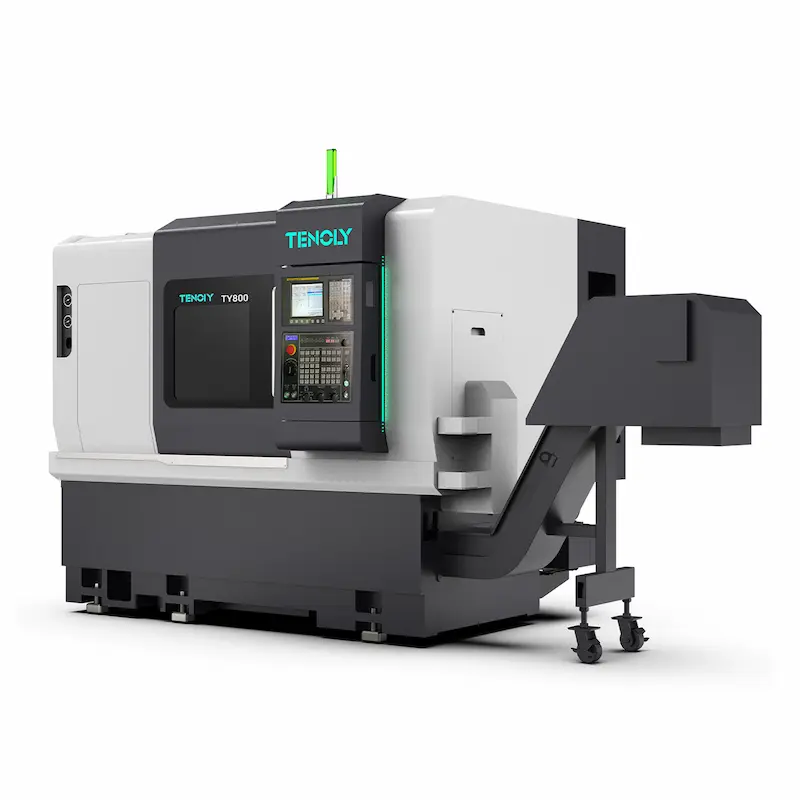
When guiding a client through a demonstration of Tenoly’s 5-axis turning and milling machine tools, do not simply rattle off technical jargon like “B-axis” or “DDR motors”—the client likely won’t understand it. Instead, ask them three key questions:
“Are you finding it easy to recruit staff these days?” — Since finding workers is difficult, why not use machines to take their place?
“Can your orders afford to wait?” — If your competitors require 7 days to fulfill an order, but you can deliver in just 2 days, that speed constitutes a tangible premium value.
“Would you rather be repairing machines or operating them?” — The mechanical axes on cheap 5-axis machines often show significant wear within a single year, whereas our DDR direct-drive motors can run maintenance-free for eight years.
Help the client do the math: “Mr. Wang, this machine costs $50,000 more than the one next door. However, it will save you $30,000 in labor costs annually. Add to that the $20,000 saved by reducing your scrap rate, and you will recoup that entire price difference within just one year. From that point on, everything else is pure profit!”
IV. 18-Month ROI: Where Do the Returns Come From?
- We have tracked the progress of numerous clients, and 18 months appears to be the universal “aha moment”—the point where they realize the investment was truly worth it:
- The First 6 Months: Production efficiency skyrockets. You can now accept high-precision orders—the kind you previously didn’t dare to take on.
- Months 6–12: Labor costs drop significantly. You discover that tasks that previously required a team of five can now be handled by just two people.
- Months 12–18: Funds from equipment depreciation allowances and government tax incentives (many regions offer subsidies for high-tech machinery) are realized and received.
- From Month 19 onward, this machine transforms into your very own “Money-Printing Machine.”
Conclusion:
The data doesn’t lie. In 2026 and beyond, efficiency will be the only true competitive moat.
If you are currently grappling with how to strike the right balance between budget constraints and performance requirements, why not contact us for a personalized, one-on-one cost optimization consultation?