Skip to content

In the industrial manufacturing sector, more and more companies are pursuing higher efficiency and more precise machining. Three-axis or four-axis machine tools are increasingly unable to meet these needs, especially when facing increasingly complex parts and stringent precision requirements.
5-axis milling and turning centers, with their multi-axis simultaneous and combined milling and turning capabilities, have become key equipment for improving production efficiency and machining quality in the aerospace, automotive, energy, medical device, and precision machinery industries.

I. What is a 5-Axis Milling and Turning Center?
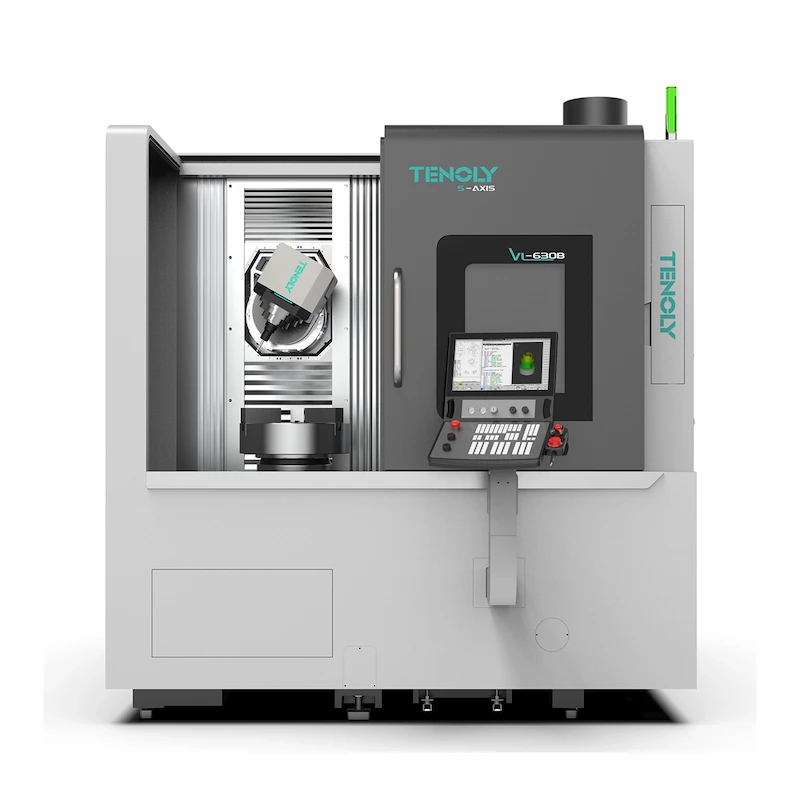
A 5-axis milling and turning center is a high-end CNC machining equipment that integrates turning and milling. Its core feature is that the turning tool can move freely in space, achieving turning at any angle, allowing parts to be machined on multiple surfaces in a single setup.
Differences from 3-axis/4-axis machines:
· 3-axis machine tools: Can only move in the X, Y, and Z directions, suitable for machining planes or simple curved surfaces.
· 4-axis machine tools: Add a rotary axis (C-axis or B-axis), allowing machining of some curved surfaces or inclined holes, but still requiring multiple setups.
· 5-axis machine: By adding rotary and tilt axes, they enable one-time machining of complex surfaces and inclined holes, significantly reducing manual operation and errors.
In other words, if your part has a complex structure and requires frequent multi-faceted machining, three-axis or four-axis machine tools often fall short, while five-axis machine tools can handle it with ease.
II. Limitations of Three-Axis and Four-Axis Machine Tools
While three-axis and four-axis CNC machine tools are stable and reliable for machining simple parts, they have significant shortcomings when machining high-precision or complex parts:
· Limited Machining Capacity: For inclined holes, complex surfaces, or parts with multi-angle features, multiple clamping operations make it difficult to guarantee accuracy.
· Low Production Efficiency: Multiple operations and frequent tool changes result in long production cycles and limited capacity.
· High Labor and Tooling Costs: Highly dependent on operator skills, multiple clamping operations and tooling use increase costs.
In aerospace, automotive precision parts, and energy equipment machining, these issues directly impact product quality, production cycle, and cost control.
III. Core Advantages of a 5-Axis Milling and Turning Center
1. Multi-Surface Machining in a Single Setup
A 5-axis machine tool can complete multiple machining operations on a part in one operation, reducing secondary positioning errors and improving part accuracy. For example, aerospace parts require error control within ±0.01mm, which a 5-axis machine tool can complete in one operation.
2. Strong Capability for Machining Complex Surfaces and Slanted Holes
The turning tool can be tilted at any angle for turning, easily handling the machining of complex surfaces, slanted holes, and high-difficulty parts. This advantage is particularly evident in industries such as automotive engine parts and precision medical devices.
3. Increased Production Efficiency
Through simultaneous turning and milling, 5-axis machine tools reduce tool changes and multi-operation time, significantly increasing overall productivity. In one automotive parts factory, the efficiency of a 5-axis machine tool was 50% higher than that of two 3-axis and 4-axis CNC machine tools.
4. Reduced Labor and Production Costs
Reducing repetitive operations and tooling usage lowers labor costs, while also reducing rework rates and increasing return on investment (ROI).
5. Meeting the Needs of High-End Manufacturing
Five-axis machine tools can process high-precision, complex parts, meeting the stringent standards of the aerospace, automotive, energy, and precision machinery industries, making enterprises more competitive in the market.
IV. Comparison Table of Five-Axis vs. Three-Axis vs. Four-Axis Machine Tools
| Dimension | 3-Axis CNC Machine | 4-Axis CNC Machine | 5-Axis Turning & Milling Center |
| Machining Accuracy | Medium | High | Very High |
| Complex Surface Machining | Limited | Partially Capable | Fully Capable |
| Setup/Clamping Times | Multiple | Multiple | Single Setup |
| Production Efficiency | Medium | Above Average | High |
| Labor Cost | High | Relatively High | Low |
| Fixture/Tooling Cost | High | Moderate | Low |
| ROI | Low | Moderate | High |
| Applicable Industries | General Part Machining | Mid-level Manufacturing | Aerospace, Automotive, Energy, Precision Machinery, Medical Devices |
This table provides a clear overview of the comprehensive advantages of five-axis machine tools in terms of efficiency, precision, and cost.
V. Key Considerations for Selecting a Five-Axis Milling and Turning Center
1. Machining Requirements Analysis
· Part Type (Complex curved surfaces, oblique holes, multi-faceted workpieces)
· Batch Size (Small-batch high-precision or large-batch production)
· Material Type (Aluminum alloy, steel, high-hardness materials, etc.)
2. Machine Tool Configuration and Brand
· Spindle Type (Power, Speed)
· Tool Magazine Capacity and Tool Change Speed
· CNC System Stability and Ease of Operation
3. Supplier and After-Sales Service
· Training, Maintenance, and Spare Parts Supply
4. Return on Investment
· Evaluate the payback period by considering increased capacity, labor savings, and reduced tooling costs.
VI. Industry Application Cases
· Aerospace Parts Machining: Multi-faceted machining completed in a single setup, with a precision error of ±0.01mm, reducing production cycle time by 30%.
· Automotive Parts Machining: Replaces two 3/4-axis machine tools, increasing productivity by 50% and reducing tooling costs by 25%.
· Energy Equipment Parts: Achieves a surface roughness of Ra0.8 for high-hardness material parts, significantly improving customer satisfaction.
· Medical Device Parts: Achieves high-precision machining to a tolerance of ±0.005mm, reducing clamping times and increasing production efficiency. These case studies resonate with readers: seeing practical applications and results helps them better understand the value of investing in 5-axis machine tools.